AI chatbot in your online store? Disclosing it is now mandatory
12 min read
by Marcel, Senior software engineer
The chat button in the bottom right corner is standard equipment in almost every online store by now. And more and more often, there's no longer a person behind it – there's a language model. That became a legal matter on August 2, 2026: Article 50(1) of the EU AI Act requires that people be told they are interacting with an AI – at the latest at the point of the first interaction. In short: if your chatbot answers with AI, you need a visible disclosure before the customer starts typing.
The short version
- The short answer: If your chatbot answers with AI, your customers have to learn that at the latest at the first interaction (Art. 50(1) EU AI Act) – mandatory since August 2, 2026.
- The practical problem: The disclosure has to sit on the chat widget – usually a third-party one. A CSS selector gets it there without touching the provider's code, even for widgets that load late.
- The provider trap: Putting your own branding on someone else's bot can make you a provider under the definition in Art. 3(3) EU AI Act – with far more obligations. (Art. 25, often cited here, only governs that role switch for high-risk systems.)
- The fix: Our EU AI Act Compliance plugin shows the disclosure automatically before the first interaction and warns you about the branding trap.
That sounds like a small thing, and technically it is. In practice, though, we see two problems. First, the disclosure usually has to live on a third-party widget you can't easily touch. Second, there's one setup where slapping your own branding on someone else's bot lands you with far more obligations than you'd expect. That's what this article is about.
Which law applies here: The EU AI Act is a regulation and applies directly across the EU. National law only determines who supervises and how penalties are enforced — in Germany that is the Bundesnetzagentur.
What exactly does Article 50(1) of the AI Act require?
The rule is refreshingly short. AI systems intended to interact directly with people have to be designed so that the person is informed they are dealing with an AI system. That information has to be there before or at the very beginning of the first interaction.
Three things matter here:
- The timing. The disclosure has to be visible before the user types anything for the first time – not in the reply afterwards, not in your legal notice, not in a PDF. A line in the chat window or right on the widget does the job; a paragraph in your privacy policy does not.
- The clarity. "Clear and distinguishable" means: plainly worded, visibly placed, not buried in the fine print. A sentence like "You're chatting with an AI assistant" is entirely enough. No legalese required.
- The obviousness exception. The obligation falls away if the use of AI is already obvious to a "reasonably well-informed, observant and circumspect" person, given the circumstances and context. Don't lean on that. A bot you've named "Lisa from customer service" and given a profile photo is the exact opposite of obvious. The more human your bot acts, the less that exception carries you.
The obligation has applied since August 2, 2026. On July 20, 2026, the European Commission adopted its final guidelines on the Article 50 transparency obligations, supplemented by a voluntary Code of Practice on Transparency of AI-Generated Content. So the waiting game is over: "the details aren't clear yet" is no longer an excuse.
And the framework is uncomfortable: breaches of Article 50 can be penalized with up to €15 million or 3% of global annual turnover (Art. 99(4)). Realistically, though, a different risk matters more for the average store – a competitor or trade association sending a cease-and-desist under unfair competition law. That arrives faster and hits small merchants too.
- the date the Art. 50 transparency obligations started applying
- Aug 2, 2026
- final European Commission guidelines on Art. 50
- July 20, 2026
- or 3% of global annual turnover as the maximum fine
- €15M
Three typical scenarios in an online store
"Chatbot" is a broad word. In Shopware projects we mostly run into these three variants – and they aren't all the same legally.
1. The AI support chat
The classic: a widget in the bottom right that answers questions about shipping, returns or availability, fed by your store data and a language model. This one is clear-cut. It's an AI system for direct interaction with people, so the disclosure is mandatory.
2. The advisory or product-finder bot
"Which model is right for me?" – interactive product advisors, size finders or configuration assistants with AI under the hood. Even if they feel more like a form: as soon as a language model produces freely worded answers, the customer is interacting with an AI. The disclosure belongs there too. Interestingly, this is often the point where store owners are surprised – the product advisor feels like a "feature" to them, not a "chatbot".
3. The human-AI hybrid
The trickiest case in practice: the bot handles the first round, and when things get complicated a staff member steps in. Or the other way around: a staff member uses AI-suggested replies but sends them personally.
A simple rule of thumb applies here: whenever an answer reaches the customer without a human reviewing it, it's an AI interaction. If the chat starts with the bot, the disclosure has to be there from the very beginning – and it's good practice to flag the handover to a human as well ("You're now talking to Anna from our team"). The switch should be visible to the customer in both directions. That isn't just legally clean, it's honest – and customers notice the difference anyway.
The provider trap: when you're suddenly more than just a deployer
Here's the part most people miss. The AI Act distinguishes between the provider and the deployer. As a store owner running an off-the-shelf chatbot product, you're normally the deployer – with a manageable set of duties.
But: under the regulation's definition, a provider is anyone who develops an AI system, or has one developed, and places it on the market or puts it into service under their own name or trademark. So if you deploy someone else's bot as a white-label solution under your own branding and sell it to customers as "our assistant", you can slide right into that role. For high-risk AI systems, Article 25 spells out the same logic explicitly: put your name or trademark on such a system, substantially modify it, or change its intended purpose, and you count as its provider – with the full set of obligations attached.
Why this matters to you: the obligation in Article 50(1) – disclosing the AI – falls on the provider, not the deployer. As long as you're visibly running a third party's product, it's their job to build the bot so that it identifies itself. The moment you present the bot as your own, it becomes yours.
In practice, that means one thing above all: don't assume someone else has handled it. The split of roles may be crystal clear in the contract – but it's your name on the store, and the customer who feels misled comes to you. Three questions worth answering:
- Does the bot appear under your name? Your own name, your own logo, its own personality instead of "powered by XY"? Then check with your legal counsel which role you're actually in.
- Does the widget show the disclosure on its own? Open the chat in an incognito window and look. In our projects, that's alarmingly often not the case – especially with bots that were installed before 2026.
- Is the disclosure translated and visible in every sales channel? An English default sentence in your German store is legally shaky and looks unprofessional.
Top tip
Run the 30-second test: open your store in a private window, click the chat button and look at what you see before you type a single character. If nothing tells you that an AI is answering, you have a gap – regardless of what your chatbot vendor's documentation claims. Do the same test on mobile and in every language your store serves.
UX: the disclosure won't hurt your conversion – quite the opposite
The most common objection we hear: "If I say an AI is answering, nobody will use the chat anymore." That worry is understandable, but it doesn't match how customers actually behave.
People spot a bot after two or three messages anyway. The only question is whether they hear it from you or figure it out themselves. The first builds trust; the second destroys it – retroactively, for everything else on your site. That's exactly why honest labelling is almost always the better call. We see the same dynamic with labelling AI images in Shopware: transparency doesn't cost you conversions, quietly misleading people does.
A few things that make the disclosure feel good rather than off-putting:
- Frame it as a benefit, not a warning. "You're chatting with our AI assistant – available around the clock, answers in seconds" beats a flat "Notice: AI system".
- Offer the exit. A line like "Prefer to talk to a human? Just type agent" takes almost all the skepticism out of it.
- Understated, but visible. The disclosure doesn't need to flash red. A small line right above the input field, or as the first message in the chat, is plenty – it just can't disappear the moment the user scrolls.
- Skip the fake humanity. If the bot is labelled anyway, you can drop the stock-photo avatar. That also takes the pressure off the question of whether the obviousness exception applies.
No customer is angry because a bot answered them. Customers get angry when they've spent ten minutes messaging "Lisa" and then realize Lisa never existed.
How to actually get the disclosure into your store
Technically there are three routes – with very different amounts of effort.
Route 1: configure it in the chatbot tool itself. The cleanest path, if your vendor supports it. Many widgets now have a field for a greeting message or a disclaimer. Check, fill in, done. The catch: not every tool has one, many don't allow per-language customization, and in some the text sits unreachable inside an iframe.
Route 2: build your own theme snippet. A developer hooks into the chat widget and injects the disclosure. It works, but it's fiddlier than it sounds: most chat widgets load asynchronously, meaning seconds after the page is built. A script that checks once on page load simply won't find the widget. So you need to watch the DOM for elements that get inserted later – and retest it after every theme update.
Route 3: a plugin that handles exactly this. That's precisely why we built the chatbot disclosure into our EU AI Act Compliance plugin. You switch it on, point it at the chat window with a CSS selector (#chat-widget, for example), and adjust the text – something like "You're chatting with an AI assistant". The disclosure appears before the first interaction, right on the widget, including widgets that only load later.
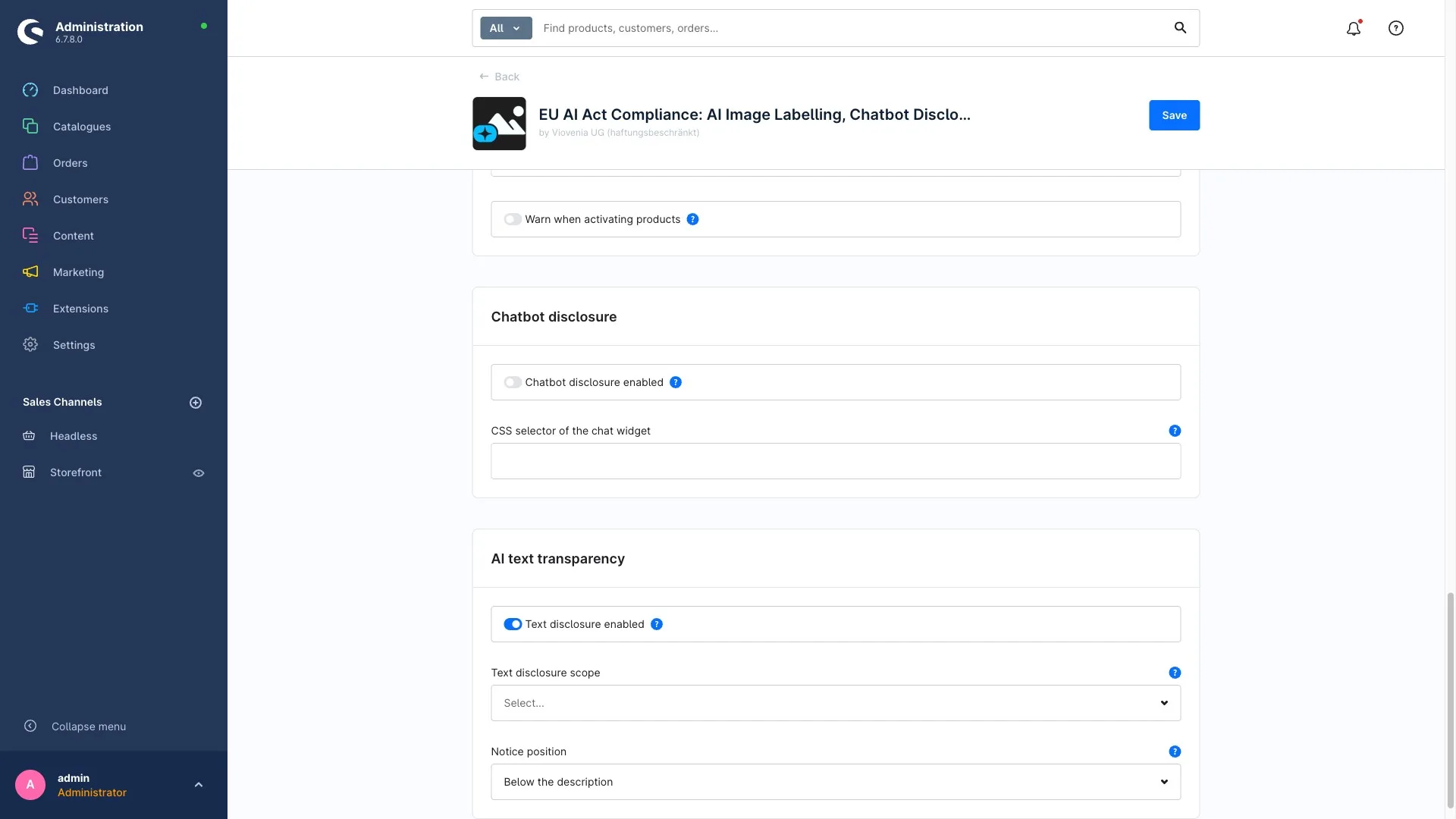
The advantage over building it yourself: the setting applies per sales channel. Your German store gets the German sentence, your international one the English version – without anyone touching code. And you're not dependent on whether your chatbot vendor eventually ships a disclaimer field.
If you're unsure which CSS selector is the right one for your setup: usually the person or agency who installed the chatbot knows – and if not, we'll find it in a few minutes. Small details like this are exactly what we solve day in, day out in Shopware plugin development.
The chatbot is just one piece
One point that tends to get lost: the chatbot disclosure is only one of the transparency obligations in Article 50. If your store uses AI, it usually affects more than the chat window – AI-generated product images, AI texts, AI videos in shopping experiences. We've written up which obligations apply to online stores overall, and who is responsible for what, in the AI labelling obligation for online stores.
So the pragmatic move is to look at the whole topic once, instead of stitching together three separate fixes. An inventory check rarely takes more than an hour: which AI is in use, what of it does the customer see, where is the disclosure missing? After that you know whether you're looking at a configuration job or a project.
And for the record: this isn't legal advice. We build the technology; assessing your specific case belongs with your legal counsel.
Frequently asked questions
Is AI chatbot disclosure required in retail?
Yes. Article 50(1) of the EU AI Act applies to anyone deploying a system that interacts directly with people — retail included, with no exemption for small stores. Customers have to be told they're talking to an AI, and they have to be told before they type their first message. The obligation has applied since August 2, 2026.
What does AI chatbot disclosure have to say?
There's no prescribed wording. What matters is that it's clear, timely and understandable — a line like “You're chatting with an AI assistant” on the widget before the conversation starts does the job. What doesn't: burying it in your privacy policy, or showing it only after the customer has already asked a question.
Who is responsible if the chatbot vendor didn't add a disclosure?
You are, as the deployer. The contract with your vendor may say otherwise, but the store runs under your name and the customer who feels misled comes to you. Check what your widget actually renders rather than assuming it was handled — that check takes a minute.
Sources
Every legal statement in this article can be checked against the original (as of August 2026):
- Regulation (EU) 2024/1689 (EU AI Act), Art. 3(3), Art. 25 and Art. 50(1)
- European Commission: FAQ on the transparency obligations
Bottom line
If an AI chatbot answers in your store, you've needed a clear disclosure since August 2, 2026 – visible, understandable, and before the customer writes their first message. Implementing it isn't a big deal once you know where to hook in. The expensive mistake is assuming your chatbot vendor took care of it while the bot runs under your name.
Our EU AI Act Compliance plugin is now available in the Shopware Store. It shows the chatbot disclosure on the widget automatically, is configurable per sales channel, and covers the remaining transparency obligations at the same time – badges for AI images and videos, collective disclosure, an AI register and a compliance dossier as evidence.
Want to know whether your chat widget shows the disclosure at all – or whether your store is properly labelled overall? Take a look at the plugin and just get in touch: in a free initial consultation we'll walk through where AI is in use on your side and what actually needs a disclosure. Honest, concrete, and with no sales pressure.