EU AI Act Compliance
Label AI images, video and text in your Shopware shop – visible in the storefront and properly documented. The transparency duties under Art. 50 of the EU AI Act have applied since 2 August 2026 – the plugin implements them in your shop, so you don’t have to explain every image by hand.
- Mandatory since 2 August 2026: AI images, video and text have to be visibly labelled (Art. 50 EU AI Act)
- The badge appears automatically – on listings, product pages, in the image zoom, in Shopping Experiences and on video
- Mostly runs by itself: folder defaults, C2PA/IPTC suggestions, review queue and coverage alerts
- Evidence included: AI register (PDF/CSV), a complete change log and a compliance dossier
Built by Viovenia · fully local, no external services, no cookies · Shopware 6.6 & 6.7
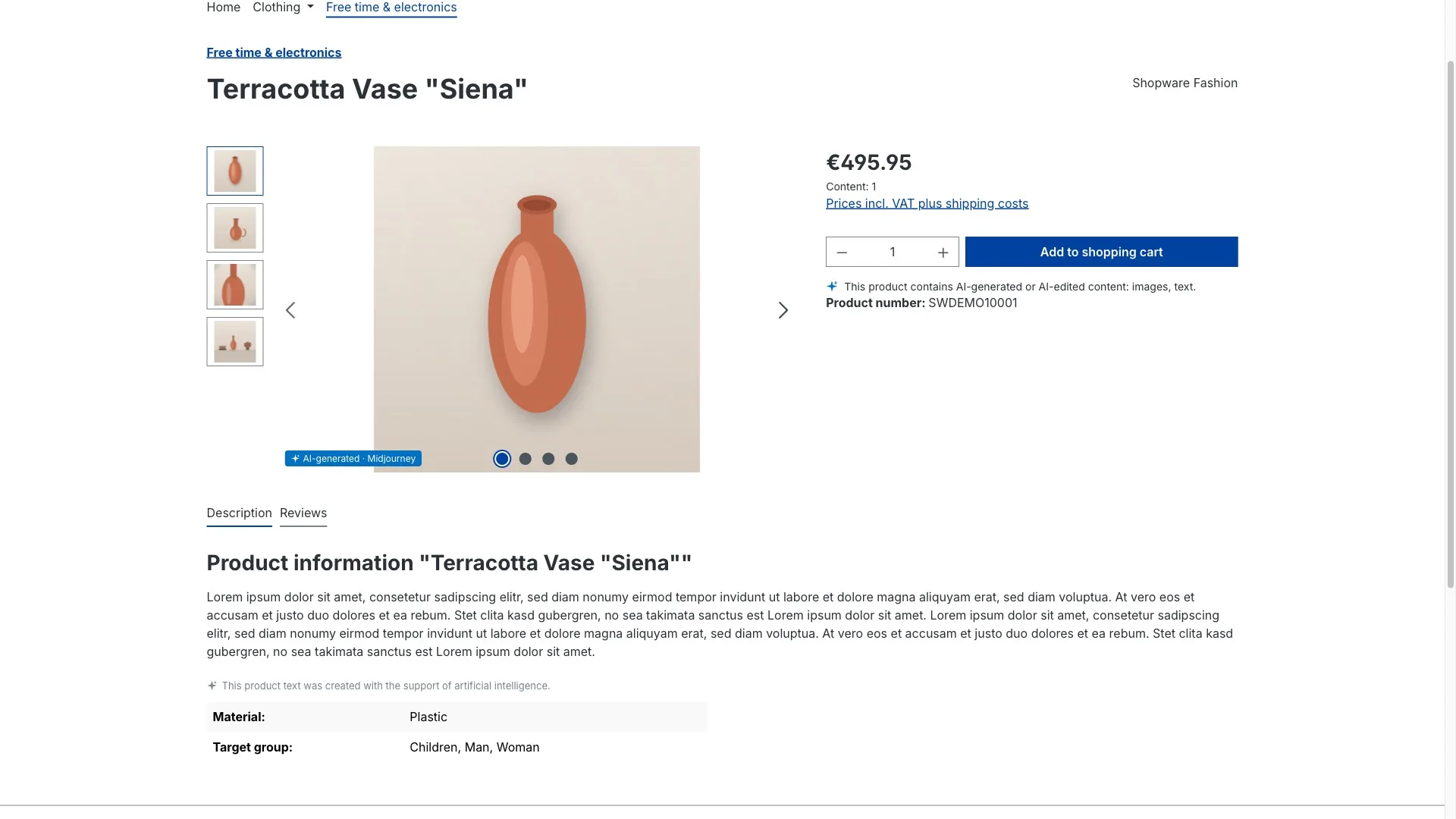
What your customers see: a badge on the image and a product-wide disclosure on the product page – no hunting required.
Why you need this now
AI images have long been business as usual in e-commerce – and since 2 August 2026 so has the duty to label them. Ignoring it risks more than a slap on the wrist.
The duty already applies
The transparency obligations under Art. 50 of the EU AI Act (Regulation (EU) 2024/1689) have applied since 2 August 2026. As a shop operator you are a deployer in the sense of the regulation: AI-generated or substantially AI-edited images showing realistic-looking persons, places or events must be visibly disclosed – and an AI chatbot has to identify itself as one.
Fines and warning letters
Art. 99(4) EU AI Act provides for fines of up to EUR 15 million or 3% of worldwide annual turnover. For most shops the more immediate risk is a competition-law warning letter – all it takes is an attentive competitor.
What the plugin takes over
This is how you implement the duties technically: you maintain the AI status, everything else happens automatically – the badge on listings, product pages, image zoom, Shopping Experiences and video, the product-wide disclosure, the chatbot notice and the full evidence trail. The plugin is prepared for the Commission’s final guidelines from July 2026. It does not replace legal advice.
Am I affected? The 60-second check
Four questions about your shop – then you know exactly which Art. 50 transparency duties apply to you.
Question 1 of 4
Do you use AI-generated or AI-edited images or videos in your shop – say, from Midjourney, DALL·E or Firefly?
Question 2 of 4
Do you run a chatbot that answers with artificial intelligence?
Question 3 of 4
Do you have product descriptions or other shop copy written by AI?
Question 4 of 4
Do you edit real photos with AI in ways that substantially change their content (beyond cropping, colour correction or retouching)?
Ready to label in three steps
Configure it properly once and the rest largely runs by itself – even across several thousand media items.
- 1
Install & configure
Install and activate the extension, then set per sales channel how the badge looks and where it appears. The quick-start assistant walks you through the first steps.
- 2
Set the status
Maintain the AI status one image at a time, or in bulk: a default status per media folder, bulk marking, CSV import. Detected C2PA/IPTC metadata provides suggestions that you confirm in the review queue.
- 3
Export your evidence
The coverage dashboard shows any remaining gaps. Export the AI register as PDF or CSV and the compliance dossier as PDF at the push of a button – ready for an audit, your data protection officer or your lawyer.
What EU AI Act Compliance does
Four AI statuses instead of gut feeling
For every media item and product text you decide: AI-generated, AI-manipulated (substantial), standard editing only, or not AI. Standard retouching deliberately stays badge-free – and you can note which AI tool the content came from.
A badge everywhere customers look
As soon as a media item is labelled, the badge shows up automatically: product listings, the product detail gallery, image zoom, CMS images and sliders as well as video elements – clearly visible from first exposure.
Video, audio and product texts too
Native video media and video CMS elements (YouTube/Vimeo) get the same badge. AI-written product text gets its own notice, and a product-wide disclosure summarises which content types – audio included – are AI-labelled.
Metadata scan instead of guesswork
C2PA/IPTC metadata from DALL·E, Firefly, Midjourney and friends is detected on upload and shown as a suggestion. If you want, the plugin applies the status automatically above a confidence threshold you set – your original files stay untouched.
Bulk work for large media libraries
A default status per media folder (folder defaults), bulk marking and CSV import sort out hundreds of media items in one go. A review queue collects every automatic suggestion for you to accept or reject.
Badge configurable per sales channel
Text and per-status labels, colours, size, style (icon/text/both), position, tooltip, a custom icon from your media library, visibility per placement, status scope and optional tool display – all per sales channel.
Chatbot disclosure under Art. 50(1)
“You are chatting with an AI assistant” – before the first interaction, right at the widget, attachable to any provider via CSS selector, including widgets that load asynchronously. An admin checklist warns you when branding the bot under your own name additionally makes you a provider (Art. 25 EU AI Act).
Evidence and automation
Coverage dashboard, a complete change log with undo, the AI register as PDF/CSV and a compliance dossier as PDF. Plus a Rule Builder condition, a Flow Builder action “Set AI media status” and an alert when too many media stay unlabelled.
A look inside the administration
Label, review, prove – all inside the Shopware admin you already know, no extra tool.
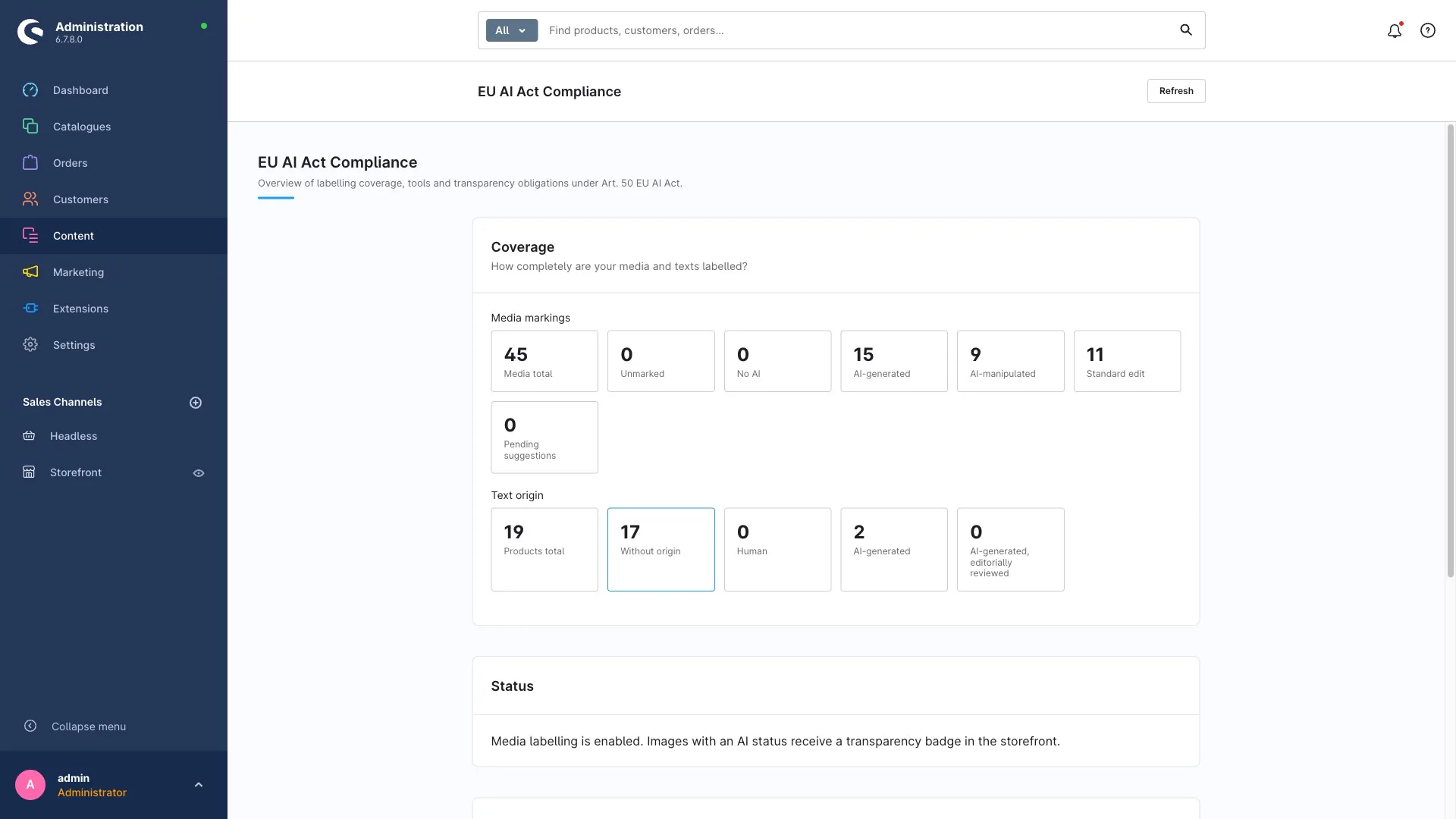
The coverage dashboard shows you where the gaps still are.
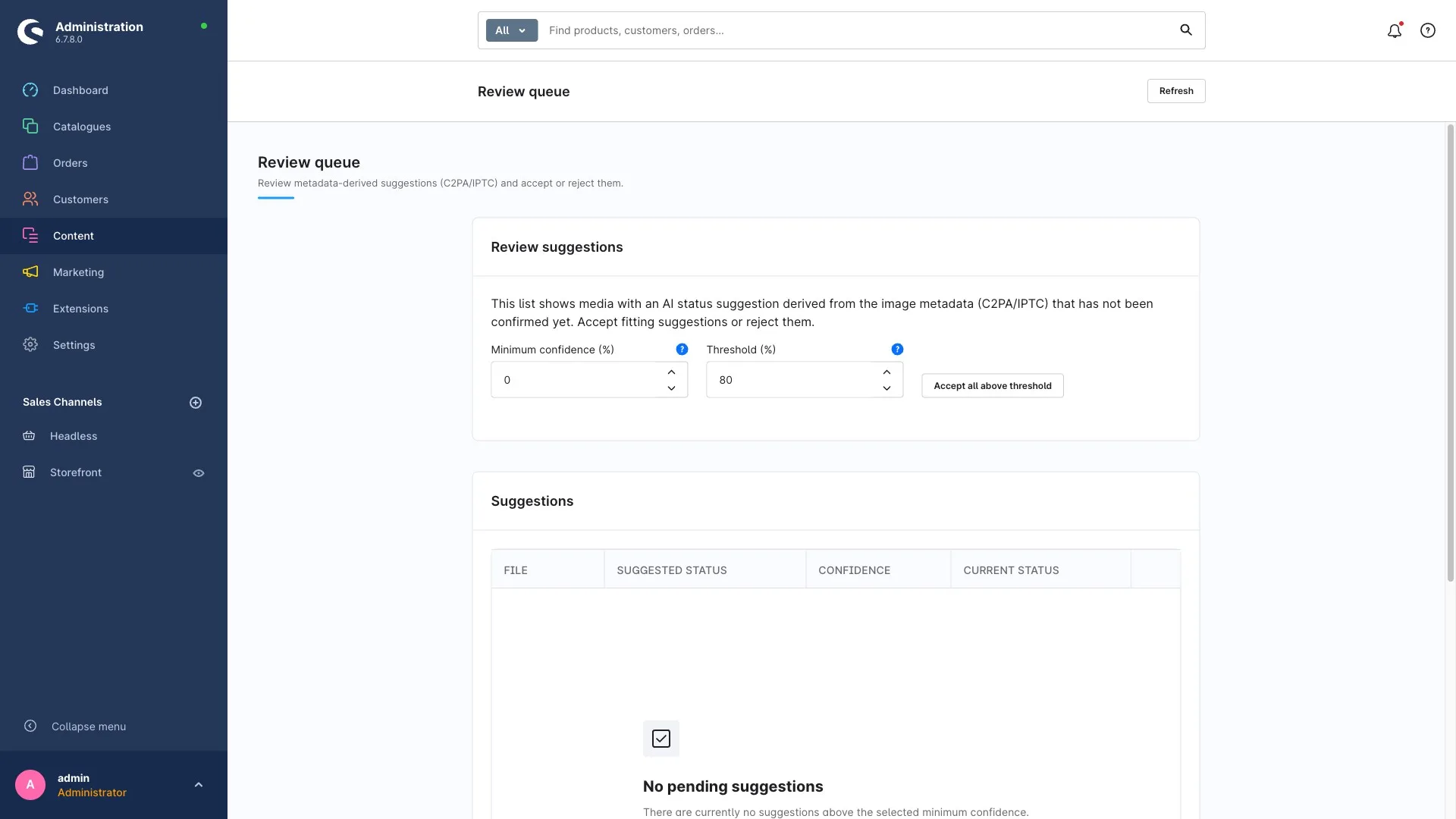
The review queue collects every automatic suggestion – you accept or reject.
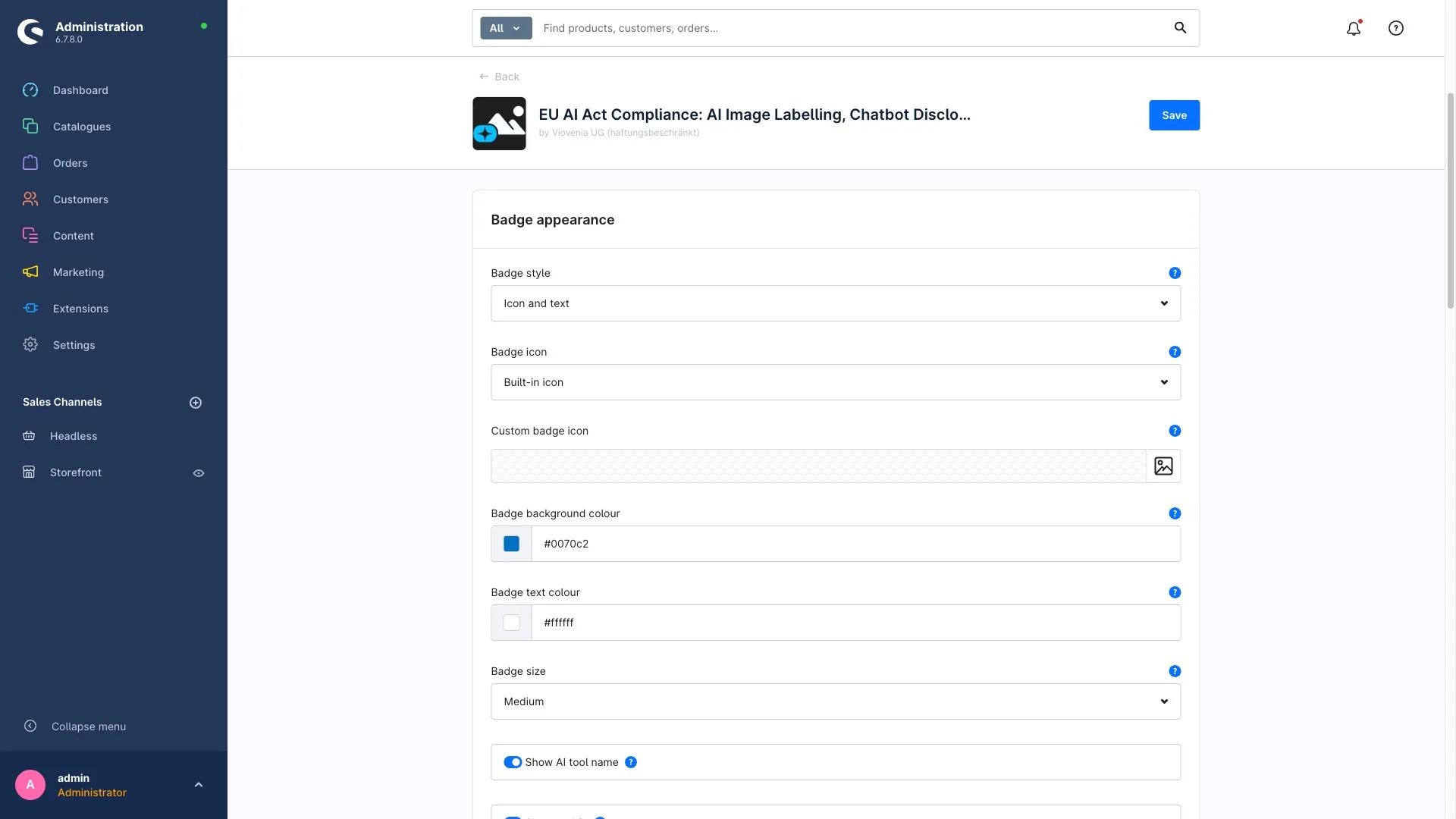
Badge text, colours, size, style and position – configurable per sales channel.
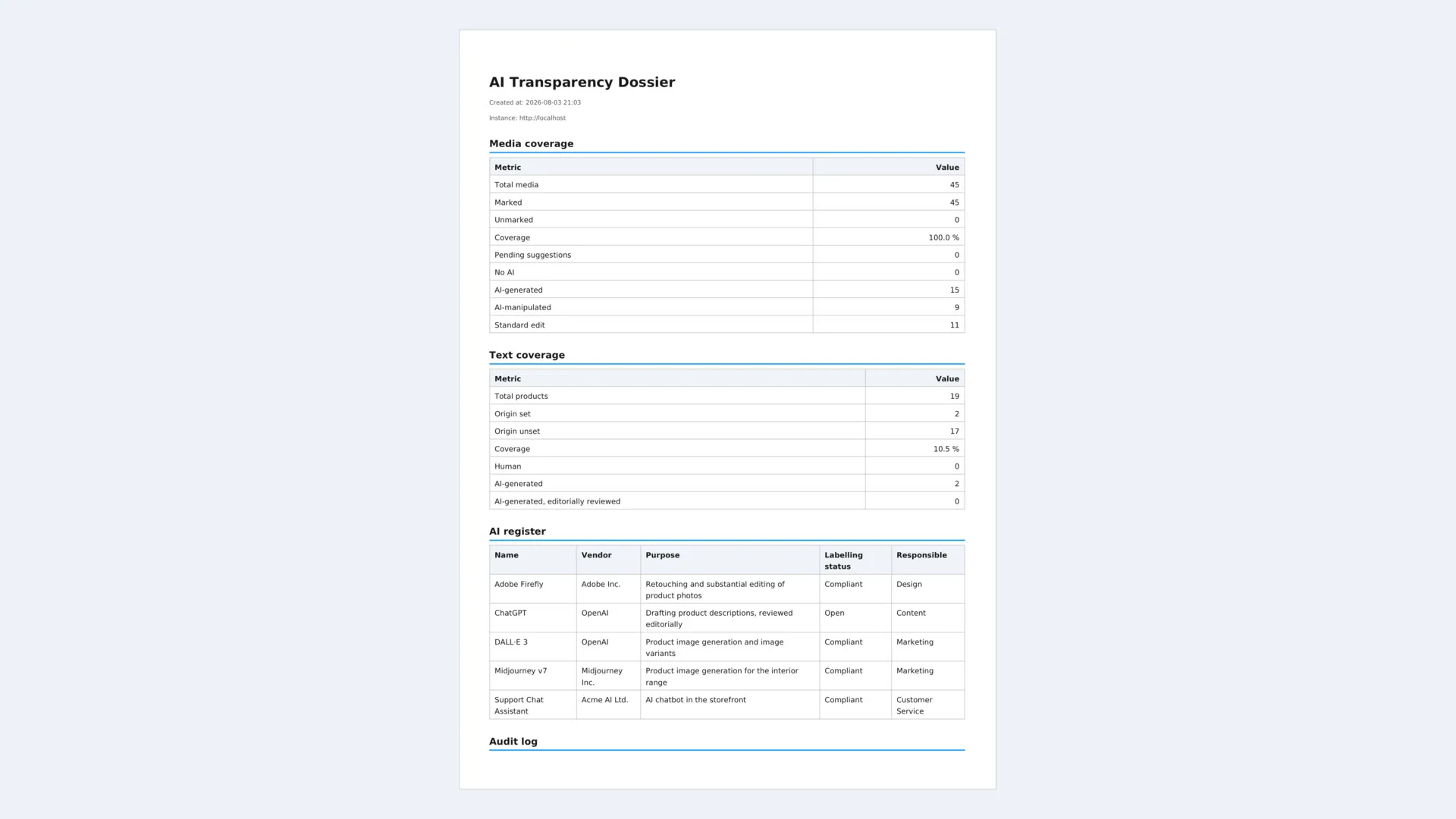
The compliance dossier bundles coverage, register and change history as a PDF.
Build it yourself – or use the plugin?
Hacking a badge into your theme sounds doable at first. But the duty doesn’t end with the badge – it covers every spot an image appears in, plus the evidence that you actually labelled.
Building it into your theme
- Template changes for listing, gallery, zoom, Shopping Experiences and video – per theme, and again after every update
- No maintenance workflow: who sets the status, who checks new uploads, who keeps track?
- No evidence: without a log and a register you can’t prove, in a dispute, since when you have been labelling
- Chatbot disclosure, product-wide disclosure and multilingual support still come on top
EU AI Act Compliance
- Badge automatically everywhere – listing, product page, zoom, Shopping Experiences, YouTube/Vimeo and native video
- Ready-made workflows: folder defaults, bulk marking, CSV import, metadata scan with review queue
- Evidence built in: coverage dashboard, complete change log, AI register and compliance dossier as PDF
- Update-safe, bilingual, configurable per sales channel – without a single line of theme code
And when the interpretation evolves, you catch up via a plugin update – instead of digging through your theme again.
Now available directly in the Shopware Store
See every feature, compatibility detail and purchase option directly in the Shopware Store. You can get the plugin there for your shop without an extra step.
Frequently asked questions
- Do I have to label AI-generated product images?
- Yes. The transparency duties under Art. 50 EU AI Act have applied since 2 August 2026. As a shop operator you are a “deployer” in the sense of the regulation: AI-generated or substantially AI-edited images showing realistic-looking persons, places or events must be visibly disclosed – at the latest when your customer first sees the image (Art. 50(4) and (5)). The quick-start assistant explains every status and the legal context so you can make that call in a traceable way.
- What happens if I don’t label?
- Art. 99(4) EU AI Act provides for fines of up to EUR 15 million or 3% of worldwide annual turnover. On top of that comes the risk of competition-law warning letters – in practice usually the first thing that hits a shop.
- What has applied since 2 August 2026?
- Since 2 August 2026 the transparency duties under Art. 50 of the EU AI Act (Regulation (EU) 2024/1689) apply to you as a deployer: visible labelling of AI-generated or substantially AI-manipulated images and video, plus the chatbot disclosure. The Commission adopted its final guidelines on 20 July 2026, complemented by the voluntary Code of Practice on Transparency of AI-Generated Content. The much-quoted grace period until 2 December 2026 from the Digital Omnibus agreement only covers the machine-readable marking under Art. 50(2) – and that is a provider duty, not yours. It changes nothing about your obligations as a deployer.
- How long does the setup take?
- The basic setup is a few minutes: install, enable labelling per sales channel, adjust the badge. The real work is setting the statuses – and that is exactly what the plugin largely takes off your plate: folder defaults, bulk marking and CSV import handle hundreds of media at once, existing C2PA metadata is prefilled as a suggestion, and the coverage dashboard shows you what is left.
- Does the plugin detect AI images automatically?
- Deliberately not via heuristics – misclassifications would be a liability risk for you. Existing C2PA/IPTC metadata (e.g. from DALL·E or Adobe Firefly) is detected on upload and shown as a suggestion, and the plugin can apply it automatically above a confidence threshold you set. Either way the decision stays traceable and with you.
- Does this apply to AI text and video too?
- Yes. Besides images the plugin supports native video media, video CMS elements (YouTube/Vimeo) and a configurable storefront notice for AI-written product text. A product-wide disclosure on the product page summarises which content types – images, video, audio, text – are AI-labelled. Audio players themselves get no badge; audio appears in the product-wide disclosure.
- Are my image files modified?
- No. Only metadata is read – your files and the embedded C2PA/IPTC information stay untouched.
- Does the plugin process personal data?
- Not in the storefront: the badge, the product-wide disclosure and the chatbot notice are purely informational, load no external services and set no cookies – so there is nothing extra for you to declare. In the admin the plugin logs which user changed a label and when, solely for your internal traceability.
- Does the plugin replace legal advice?
- No. It shows you how to implement and document the duties technically – the legal assessment of your specific case belongs with a lawyer. And the machine-readable marking of the outputs (Art. 50(2)) is the job of the respective AI provider, not yours: the Digital Omnibus agreement grants a grace period for that until 2 December 2026, and only for systems placed on the market before 2 August 2026.
Tell us about your project
Free intro call, no strings attached – we get back to you personally and quickly.