EmpCo in 2026: the EU legal guarantee notice, GARAN and product information in Shopware
7 min read
by Marcel, Senior software engineer
On 27 September 2026, EU rules change what consumers should see before buying goods. Two requirements are easy to confuse: the standard notice about the consumer's legal guarantee and the product-specific GARAN label for certain manufacturer guarantees. Repairability information has its own conditions. The rules come from the adopted EmpCo Directive (EU) 2024/825; the Implementing Regulation (EU) 2025/1960 sets the two labels' designs.
The short version
Legal guarantee notice: If you sell consumer goods, display the standard EU notice prominently from 27 September 2026. A sentence you wrote yourself about a two-year warranty is not a substitute.
GARAN: The label applies only where the manufacturer offers a
free commercial guarantee of durability for the whole product lasting more than two years
.
Shopware: Versions 6.6.10.24 and 6.7.14.0 both include native support. You still need to enable the notice, identify qualifying products and check the customer-facing result.
Repair information: Provide an EU repairability score where one applies. Otherwise, certain repair information is required if the manufacturer has made it available to the trader.
The directive works through national law. Germany has published its consumer contract amendment and UWG amendment. The EmpCo rules apply from 27 September 2026. If you sell into other EU countries, check their national rules as well. This is a technical guide, not legal advice about your particular products.
Which information belongs where?
| Information | When does it apply? | What to check in the store |
|---|---|---|
| EU legal guarantee notice | When selling consumer goods to consumers | Display the official notice prominently and in colour online. A general reminder on the merchant's website is possible; check every relevant language and sales channel. |
| GARAN label | A free manufacturer durability guarantee covers the whole good for more than two years | Identify qualifying products and variants; provide the correct guarantee duration, brand and model; make the official label visible with the offer. |
| EU repairability score | Where an EU-level score has been established for that type of good | Map the official score and its source to the correct product. Do not pass off a homemade scale as the EU score. |
| Other repair information | Where no EU score applies and the manufacturer has supplied the information | Record available spare parts, estimated costs and ordering procedure, plus available repair manuals and restrictions. |
The distinction between the score and manufacturer-supplied repair information is set out in Article 2 of the EmpCo Directive. It does not create a blanket duty to invent a repair score for every product or say “no spare parts available” whenever a field is empty.
The legal guarantee notice is a standard EU design
According to the European Commission's business guide, an online merchant may display the notice as a general reminder on its website. The notice has a fixed design, includes a QR code and must appear in colour online. A plain text warranty note on a product page may add context, but it does not replace the official notice.
Check the rendered storefront. A standard Shopware checkout, a customised checkout, an app storefront and different sales channels may show different results.
GARAN only applies to a particular manufacturer guarantee
The Commission's guide lists three cumulative conditions:
- The manufacturer offers a commercial guarantee of durability.
- It costs the consumer nothing and covers the entire good.
- It lasts for more than two years.
A three-year guarantee covering only the battery is therefore not a GARAN case. The manufacturer supplies the relevant guarantee details, while the seller needs to establish which exact models qualify. The legal guarantee is a statutory right against the seller; GARAN concerns a separate promise by the manufacturer.
How to implement the labels in Shopware 6.6 and 6.7
Shopware added native support for both the notice and GARAN in 6.7.14.0 and 6.6.10.24. A shop on 6.6 does not need to move to 6.7 solely for this core feature. It may still need an update within its release line and a storefront check. Shopware also fixed a GARAN template bug in 6.6.10.27.
Swipe sideways to read the table →
| Shopware version | Native label support | What to do next |
|---|---|---|
| 6.6 before 6.6.10.24 | Not included yet | Plan a tested update within 6.6 or another suitable solution. |
| 6.6.10.24 through 6.6.10.26 | Legal guarantee notice and GARAN included | Check the patch level and rendered labels; 6.6.10.27 fixes a GARAN template bug. |
| 6.6.10.27 and later | Both included, GARAN template fix applied | Test settings, product data and storefront output in your shop. |
| 6.7.14.0 and later | Both included | Test settings, product data and storefront output; track open display questions. |
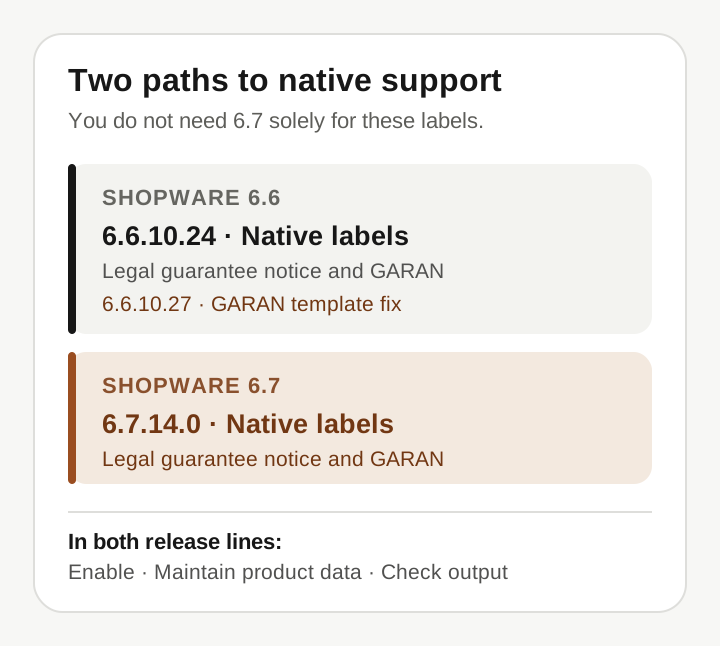
Shopware says no additional extension is required for the core label features. The practical work remains:
- Check your version and sales channels. Confirm that your shop runs at least 6.6.10.24 or 6.7.14.0 and identify the affected B2C channels. Older versions need a tested update or another implementation path.
- Enable the legal guarantee notice. Shopware places the switch under Settings → Cart settings → Checkout and allows a sales-channel override. Check every storefront language you use.
- Identify GARAN products. Maintain the label only for qualifying manufacturer guarantees. Shopware uses the manufacturer and manufacturer product number and supports variant inheritance.
- Test a real purchase. Inspect a qualifying product page, the cart, checkout, order confirmation page and confirmation email, including mobile and any custom theme or checkout extension.
- Track display issues. An open Shopware issue, #20356, questions the use of a mere label link in checkout. That report is not a binding legal conclusion. It is a reason to inspect what customers can actually see in your store and follow Shopware updates.
Shopware explicitly leaves the assessment of individual products and guarantees to the merchant.
Repair information and environmental claims still need attention
EmpCo also changes pre-contractual information on durability and repairability and tightens rules for environmental marketing. Separate official values, manufacturer information and your own claims in the product data. Keep a source for each value, and show an item only where its conditions are met.
Smartphones and tablets provide an example: an EU energy label with a repairability class has its own display requirements. A homemade “8 out of 10” is not the same official score. Sellers in France may also need to account for national repairability or durability indices for certain categories.
Review product descriptions, category copy, banners and emails for environmental claims and sustainability labels. Vague claims without the evidence required by the directive, unauthorised sustainability labels and advertising statutory rights as special benefits can be problematic. The European Commission explains the changes and the application date.
What our Shopware plugin covers
Our upcoming Right to Repair & EmpCo plugin addresses structured repair information and the after-sales claims process. Its product block can display maintained repairability and spare-part data. This is separate from Shopware's new native support for the legal guarantee notice and GARAN.
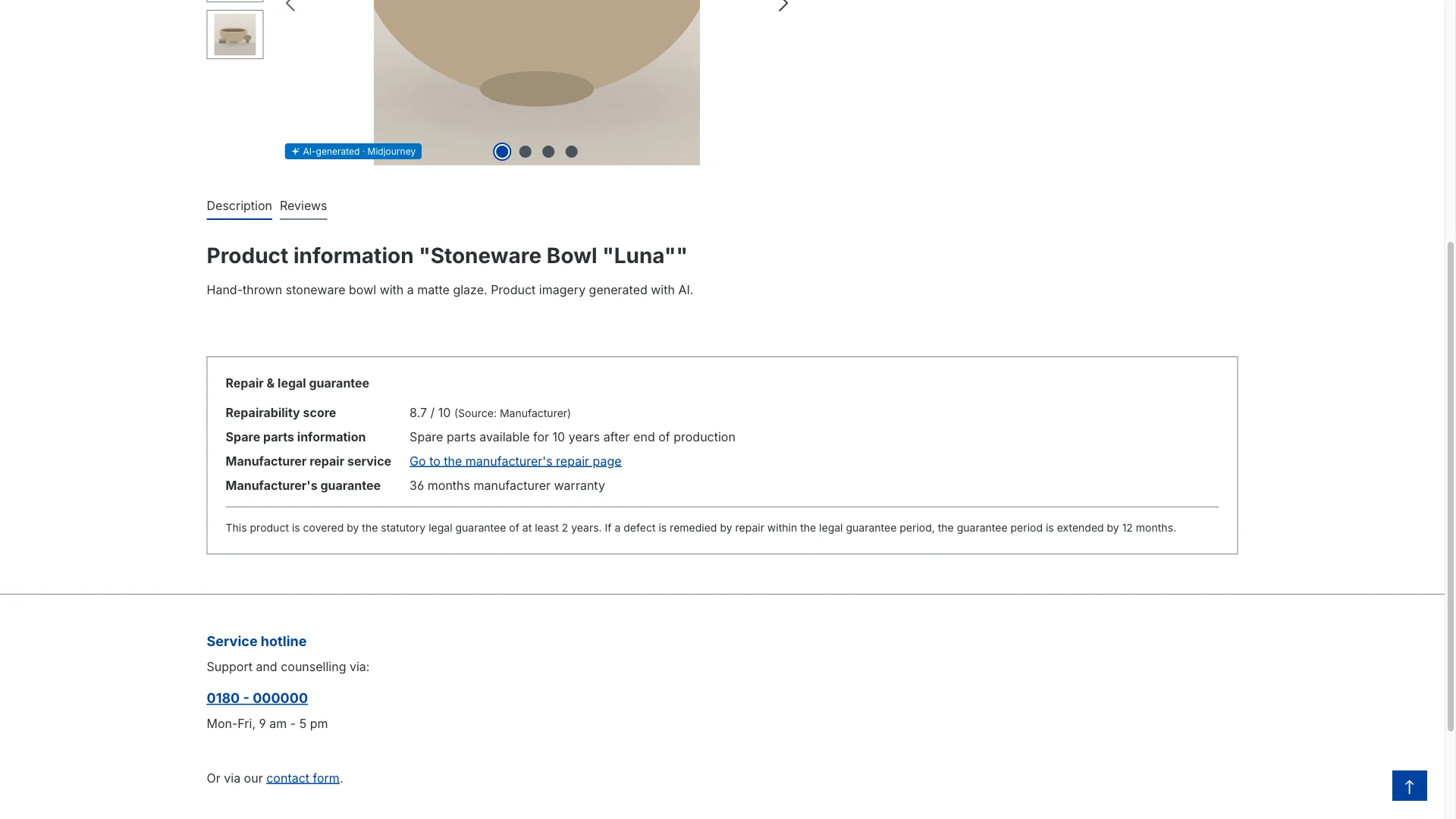
For planning purposes: The plain legal-guarantee text currently described for our plugin is not the official EU notice. Use Shopware's native feature, another suitable solution or a separately reviewed implementation for the new labels. A plugin cannot determine whether a manufacturer's guarantee meets the legal conditions.
Checklist before 27 September
- Map consumer-goods sales channels and storefront languages.
- Display the official legal guarantee notice and verify its actual, full-colour rendering.
- Document the manufacturer, coverage, cost and duration for each potential GARAN product.
- Audit repair data and environmental claims against their sources.
- Test product page, cart, checkout, confirmation and email on desktop and mobile.
- Have the legal classification of products and target markets reviewed by qualified counsel.
Sources and current status
Last updated: 26 September 2026. The directive has been adopted and transposed in Germany; the new rules apply from 27 September 2026. Shopware's label feature is available from 6.6.10.24 in the 6.6 line and 6.7.14.0 in the 6.7 line. Check later Shopware releases and open issues again before relying on a particular implementation.
- Directive (EU) 2024/825
- Implementing Regulation (EU) 2025/1960
- EU business guide to the legal guarantee notice and GARAN
- Shopware 6.7.14.0 release news
- Shopware 6.6.10.24 release notes: native label support
- Shopware 6.6.10.27 release notes: GARAN template fix
- Shopware issue #20356
Want to know whether your Shopware store handles both label cases? Send us your Shopware version and two example products, one with and one without a longer manufacturer guarantee, through our contact form. We can inspect the technical presentation and the product data with you; your legal adviser can then assess the guarantee conditions.