The EU right to repair: what online sellers need to know now
11 min read
by Marcel, Senior software engineer
A customer gets in touch: the cordless vacuum he bought from you eight months ago won't charge any more. Until recently the answer was easy – ship a replacement, case closed, customer happy. Since 31 July 2026 that reaction isn't just a service decision any more, it's a legal one. The right to repair under Directive (EU) 2024/1799 requires you to tell your customer that they can choose between repair and replacement. And if they go for the repair, the warranty on that item is extended once by twelve months.
The short version
- The short answer: As a seller, when a defect appears within the statutory warranty you have to inform customers about the choice between repair and replacement – and after a repair the warranty period is extended once by twelve months.
- Since when: The directive's standard transposition deadline was 31 July 2026. In Germany, parliament passed the implementing act on 25 June 2026; national implementation can differ from country to country.
- The underrated part: The obligations aren't the hard bit – the evidence is. When did you tell whom about what, and when does the extended period run out?
- The fix: In Shopware, our plugin Right to Repair & EmpCo: Claims and Repairability handles the workflow, the timestamps and the deadline maths largely automatically.
This article walks through it in order: what the directive actually regulates, which part applies to you as the seller and which part to manufacturers, what the deadline means in practice – and why the real effort isn't in the repair, it's in the documentation.
One thing upfront: we're software engineers, not lawyers. What follows is how we read the rules from day-to-day practice – it is not legal advice. For a binding assessment of your specific situation, and for the wording you publish, talk to a law firm specialising in IT and consumer law.
Which law applies here: Directive (EU) 2024/1799 applies EU-wide, but the concrete obligations reach you through the national law of the country you sell into. The specifics in this article follow the German implementation. The principles carry over across the EU; the deadlines, wording requirements and enforcement do not automatically.
What the right to repair regulates – the short answer
Directive (EU) 2024/1799 has a simple goal: make repairing more attractive than throwing away and buying new. To get there, it works on two completely different levels:
- Inside the warranty period – this is where you as the seller are on the hook. If there's a defect, your customer needs to know they can pick repair instead of replacement. If they pick repair, they get twelve extra months of warranty for it.
- Outside the warranty period – this one is on manufacturers. For certain product groups listed in Annex II of the directive (washing machines, dryers, dishwashers, refrigerators, vacuum cleaners, smartphones, tablets, e-bikes and servers, among others) there is a standalone repair claim against the manufacturer, even after the warranty has expired.
For a store owner, point 1 is the relevant one. You should know point 2 anyway, because customers will raise it with you – and because you may need to check whether parts of the manufacturer obligations can land on you through your supply chain.
Are you affected? Probably yes – regardless of what you sell
Here's the first misunderstanding we run into constantly: "I don't sell washing machines, this doesn't concern me."
That's only true for the manufacturer part. The Annex II list defines which product groups carry the additional repair claim against the manufacturer. The seller obligations, on the other hand, hang off the ordinary statutory warranty – and that covers practically everything you sell to consumers. Coffee machine, garden shears, office chair: as soon as a defect shows up within the warranty period, you're in scope.
Company size doesn't help either. There's no revenue threshold, no SME exemption, no grace period for one-person shops. If you sell to consumers, you're in.
The two obligations that hit you as a seller
1. Telling the customer about the choice
When a customer reports a defect within the statutory warranty period, you have to inform them that they can choose between repair and replacement. That sounds trivial, but it has an uncomfortable flip side: if it's ever disputed, you need to be able to show that you gave that information – and when.
In practice we see the exact opposite at a lot of stores. The complaint arrives in a shared inbox, someone writes "We'll send you a new unit", and three months later nobody can reconstruct whether the choice was ever mentioned. Commercially the reflex even makes sense: replacement is usually faster and cheaper than repair logistics. It's just no longer the only option you're allowed to put on the table.
2. Extending the warranty by twelve months
If the goods are repaired, the statutory warranty period for that item is extended once by twelve months. Two years become three – but only for repair, not for replacement, and only once per case.
That has two consequences most sellers underestimate:
- Financially. A repaired item stays in your risk window for twelve extra months. In categories with thin margins and high defect rates, that's a real number.
- Operationally. For every repaired item you need to know when the extended period runs out. If the same customer comes back 30 months after purchase, the question "expired or not?" suddenly isn't trivial – it depends on a case that happened a year and a half ago.
The deadline: 31 July 2026 – and what applies nationally
The directive's standard transposition deadline was 31 July 2026. By that date, member states had to bring the rules into national law. So it's already behind us.
In Germany, parliament passed the implementing act on 25 June 2026, largely as a one-to-one adoption of the directive into the civil code. Under the bill, the rules on extending the warranty period apply to goods bought on or after the cut-off date; older orders stay under the previous regime.
Important if you sell across borders: national implementation can differ – in the details, in the entry into force and in the transitional rules. If you ship to Austria, France or the Netherlands, check each market's cut-off date and each market's base warranty period separately. A store that hard-codes one single rule for all markets will be wrong in at least one of them.
- standard transposition deadline for Directive (EU) 2024/1799
- 31 Jul 2026
- one-off extension of the warranty period after a repair
- +12 months
- possible total where the base warranty period was 24 months
- 36 months
The real sticking point: evidence
If you take one thing away from this article, make it this one. The new obligations are manageable in substance. What creates the workload is being able to prove you met them.
Picture a dispute 20 months after the purchase. The questions on the table will be:
- When exactly was the defect reported?
- Was the customer told about their choice – and when?
- What did they pick, repair or replacement?
- When was it repaired, and when does the extended period end?
Four questions, four dates. An email inbox answers the first one halfway reliably at best. A spreadsheet is only as good as the discipline of whoever maintains it – and it has no concept of "when was this row actually changed?". This is the pattern we keep seeing in projects: the processes exist, they're just not recorded anywhere in a way that proves anything when it matters.
Top tip
Introduce the timestamp for the choice notice before you optimise anything else. It's the single data point you'll need most urgently in a dispute, and the one nobody can reconstruct after the fact. Deadline maths, reporting and polished customer emails can follow at your own pace – last week's missing evidence never can.
Why a spreadsheet and a shared inbox don't cut it
Three reasons that bite in practice:
First, there's no timeline. A spreadsheet cell tells you that "notice given" is written there. It doesn't tell you whether that was typed on 3 March or yesterday, right before the lawyer's letter arrived. Evidence without a reliable timestamp is, when it counts, not really evidence.
Second, there's no deadline logic. Delivery date plus base warranty period plus possibly twelve months, taking into account the destination country and whether the case falls under the new rules at all – nobody computes that reliably in their head, certainly not across 40 cases a month.
Third, there's no visibility. Complaints go quiet. A case that has been sitting in "reported" for three weeks goes unnoticed in an inbox – on a board view with a reminder for open cases it jumps out immediately.
Then there's the customer side. Every "what's the status?" email costs you support time you'd save if the customer could simply look it up in their account.
Checklist: what to do now
- Work out when the rules apply to you. Clarify the cut-off date per target market instead of setting one blanket date for all countries.
- Write your complaints process down. Who takes reports, who decides, who communicates? A paragraph in your team wiki is a fine start.
- Fix the wording of the choice notice. One template that always gets used – not 15 individually phrased emails.
- Introduce timestamps. Reported, notice given, remedy chosen, repaired, closed. Five dates, set automatically instead of typed by hand.
- Let deadlines be calculated. Store the base warranty period per sales channel and country, add the extension automatically.
- Give customers transparency. Show the status in the customer account, confirm every status change by email.
- Decide on retention. How long do you keep closed cases? That's a trade-off between your documentation needs and the storage limitation principle under the GDPR – make it deliberately.
- Have your texts reviewed. Anything a customer gets to read should have been checked by a lawyer once.
Our answer: our Shopware plugin "Right to Repair & EmpCo"
That's exactly the problem we built a Shopware plugin for: Right to Repair & EmpCo: Claims and Repairability. The idea behind it is unspectacular but effective – you run every complaint through a fixed sequence, and along the way the plugin produces exactly the documentation you'll need later.
At its core sits a guided remedy workflow with four statuses: reported → notice given → remedy chosen → closed. Every step sets its timestamp automatically and lands in the activity log.
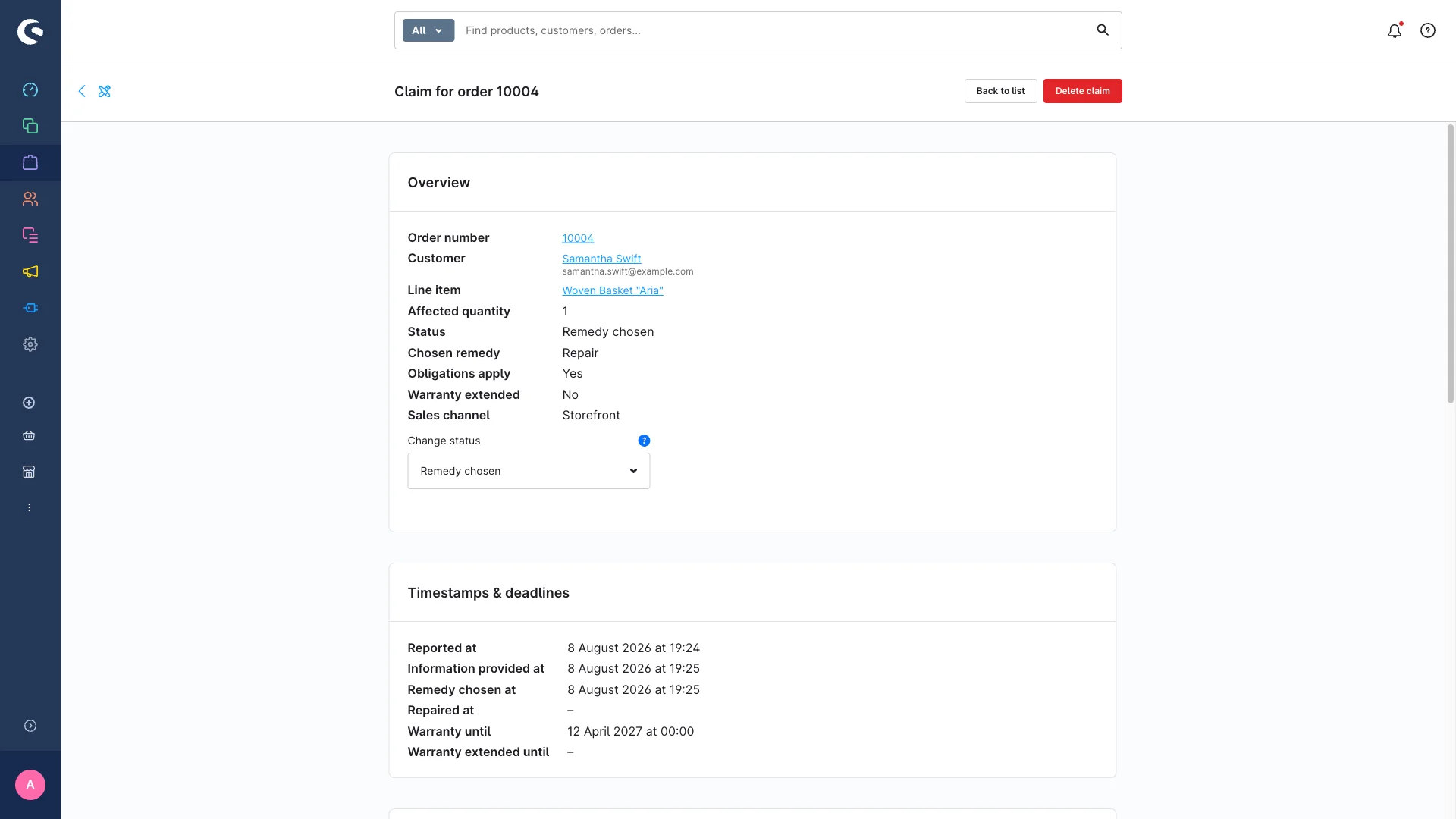
What the plugin covers:
- Timestamped evidence of the choice notice. The timestamp is always set – even if the email fails to send. That's precisely when you want it.
- Automatic +12-month extension. Once per line item, only for repairs, only where the case falls under the new obligations. You set the base warranty period per sales channel, and country-specific values take precedence.
- Cut-off logic based on the order date. Orders placed before your configured cut-off date are flagged as "voluntary" – you can still run them through the workflow, just without triggering an extension.
- Kanban board and list view. Drag cases between statuses, filter, search – and see what's going stale.
- Status emails and a customer account view. Customers see their case in their account, report defects there themselves and choose between repair and replacement right in the storefront.
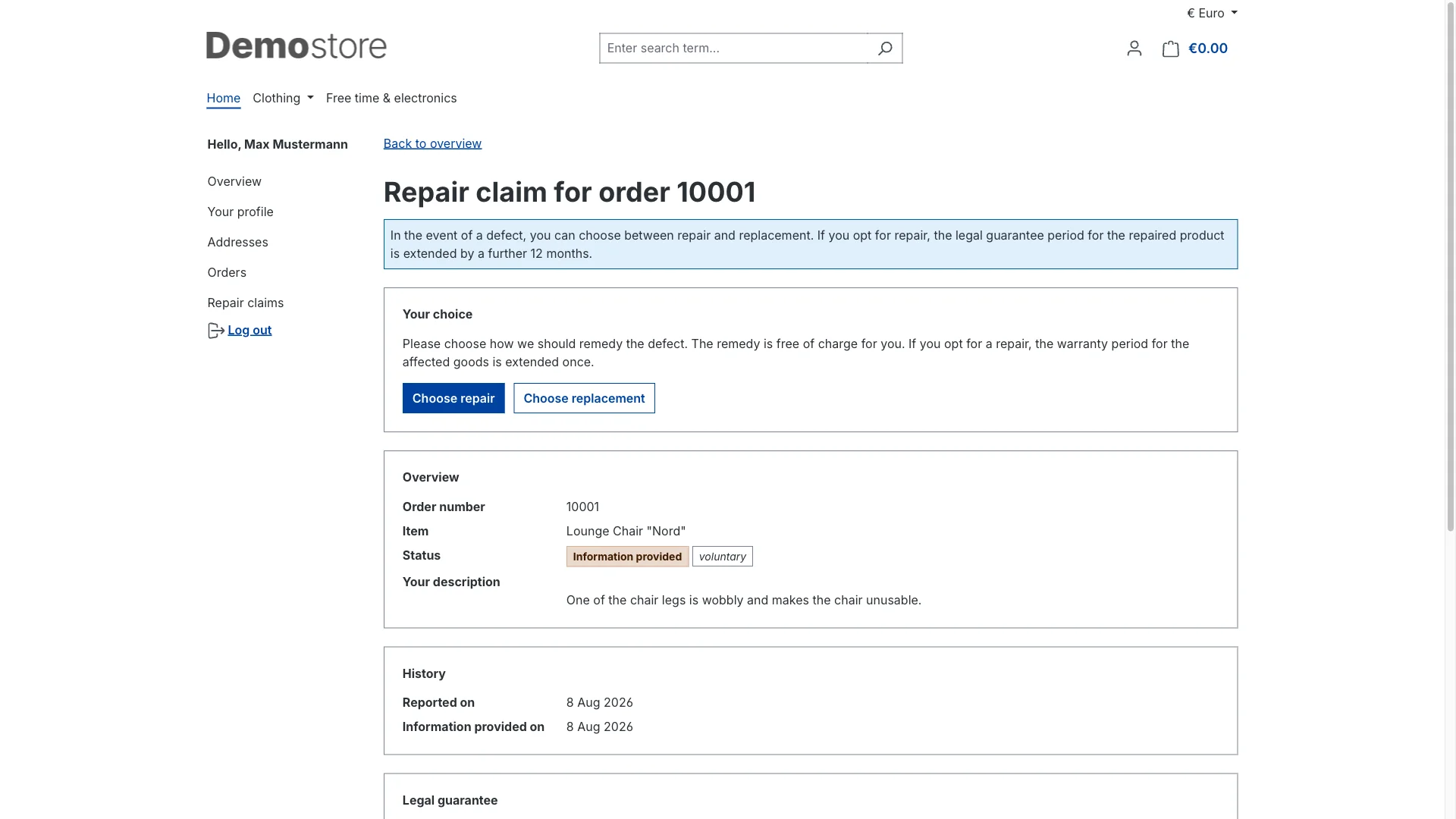
Everything is configurable per sales channel, everything ships switched off by default, and a guided onboarding walks you through the setup. On top of that there are team permissions, a CSV export for your records, an email preview that sends nothing, and snippets for every customer-facing sentence – so your lawyer can adjust the wording without anyone touching code.
What the plugin deliberately does not do: judge whether a claim is legally valid. The "obligations applicable" flag is a default derived from the order date, not a legal assessment. And the case itself – repair, replacement, talking to the customer – is still your job. The plugin documents the process, it doesn't run it for you.
The plugin is coming to the Shopware Store soon. If you don't want to wait: take a look at the plugin page and get in touch – we'll give you early access and go through your process together. How we approach Shopware plugins in general is on our services page; why building your own is often cheaper than yet another store subscription and what such a build roughly costs we've written up separately.
Sources
Every legal statement in this article can be checked against the original (as of August 2026):
- Directive (EU) 2024/1799 (right to repair), incl. Annex II
- Directive (EU) 2019/771 (sale of goods), Art. 10
Wrapping up
The right to repair isn't a future topic any more – the standard deadline is behind us, and in Germany the implementation has been passed. For you as a seller it comes down to two manageable obligations: tell customers about the choice and add twelve months after a repair.
The effort isn't in the obligations, it's in the evidence. If you keep handling complaints via inbox and spreadsheet, you may well be meeting the rules – you just can't show it. And when it's disputed, that's the only thing that counts.
Want to know whether your complaints process would hold up? Then let's look at it together in a free initial consultation. We'll walk through your workflow honestly, tell you where the evidence breaks down, and show you the plugin live on your store. No obligation, no sales pressure – and afterwards you'll know exactly where you stand.