Since July 23, 2026 the right to repair is part of the German Civil Code (BGB). The "Act transposing Directive (EU) 2024/1799 on promoting the repair of goods" of July 16, 2026 was published in the Federal Law Gazette on July 22 (BGBl. 2026 I No. 212) and applies to consumer sales contracts concluded from July 31, 2026. Germany met the deadline – unlike 18 other member states, which received letters of formal notice from the Commission on September 25, 2026.
In August we explained what the directive means for online sellers. Back then there was a bill. Now there is a law, and it's worth going through it provision by provision: what's new, what it says, from when it applies to which contract – and what that means for your store, especially if you sell into Germany from abroad.
The short version
- In force since July 23, 2026, applicable to consumer sales contracts concluded from July 31, 2026 (Art. 229 § 72 EGBGB). The manufacturer repair duty applies since July 23 to devices bought earlier as well.
- Section 475(4) BGB (new): before remedying a defect you must inform the consumer about the choice between repair and replacement and about the twelve-month extension – no prescribed form, tied to the specific claim; a blanket sentence in your terms is not enough under the prevailing reading.
- Section 475e(5) BGB (new): a repair that is actually carried out extends the limitation period once by twelve months – appended to the end, not restarted; the burden-of-proof reversal under Section 477 doesn't restart.
- Sections 479a–479g BGB (new): a repair duty for manufacturers across eleven Annex II product groups – with a chain of responsibility down to the distributor when the manufacturer sits outside the EU.
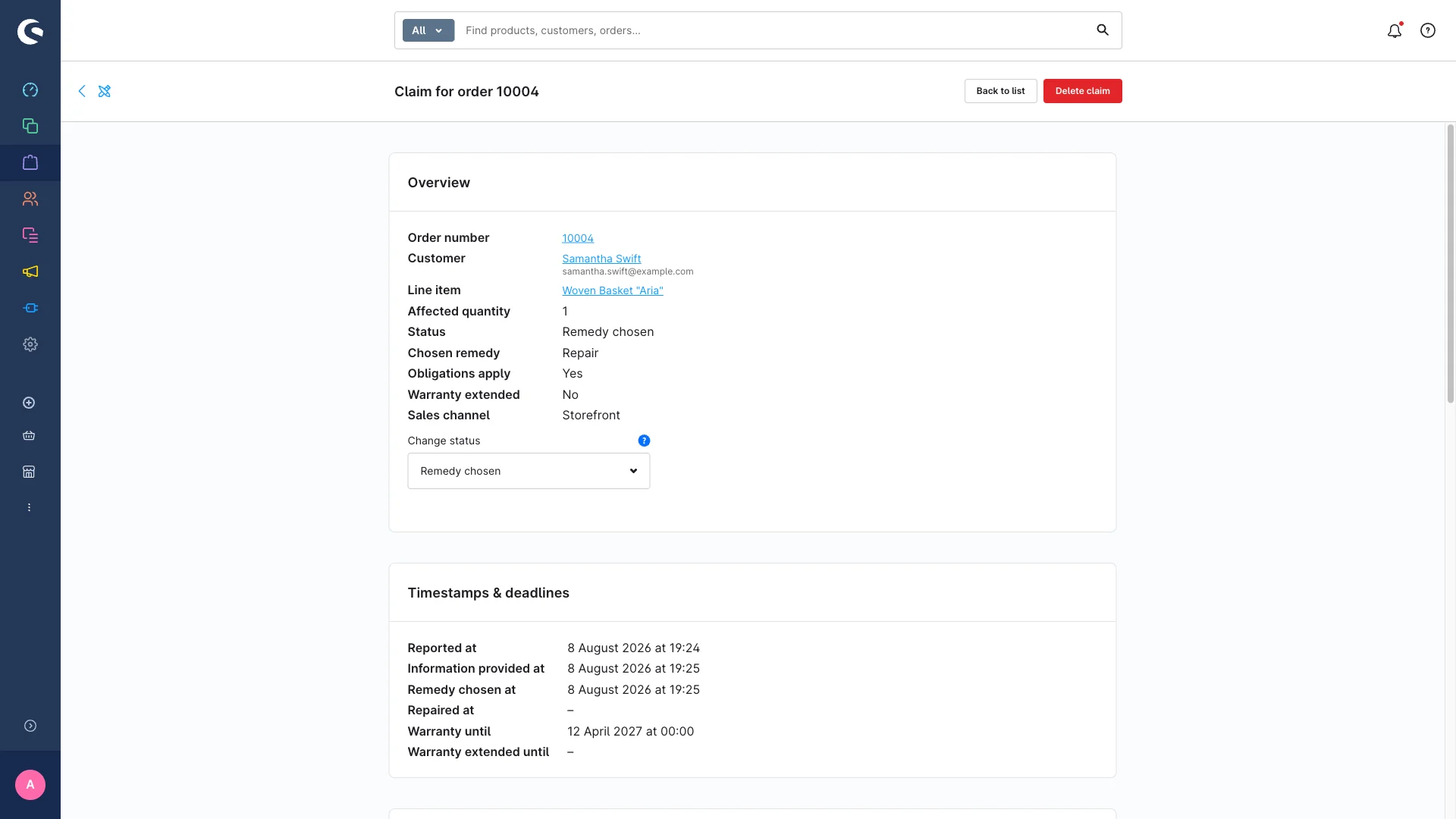
- Tooling: in Shopware, our plugin Right to Repair & EmpCo handles the evidence of the notice and the deadline math.
The usual disclaimer: we're software engineers, not lawyers. Quotes come from the statute and the Bundestag papers, the framing is our practical summary – not legal advice. All sources are at the end, as of November 7, 2026. Section references use the German "§" convention where helpful; BGB is the Civil Code, EGBGB its Introductory Act.
The timeline: from ministry draft to Federal Law Gazette
| Step | Date | Document |
|---|---|---|
| Ministry of Justice draft bill | January 15, 2026 | Consultation until February 19, 2026 |
| Cabinet decision (government bill) | March 25, 2026 | Ministry press release |
| Bill introduced in the Bundestag | May 13, 2026 | Bundestag paper 21/5923 |
| First reading, referral to the Legal Affairs Committee | May 20, 2026 | – |
| Public hearing in the committee | June 10, 2026 | – |
| Committee recommendation | June 24, 2026 | Bundestag paper 21/6693 |
| Second and third reading, adoption | June 25, 2026 | Yes: CDU/CSU, SPD, Greens |
| Bundesrat, second passage | July 10, 2026 | Bundesrat paper 389/26, no mediation request |
| Signed into law | July 16, 2026 | – |
| Published | July 22, 2026 | BGBl. 2026 I No. 212 |
| Entry into force | July 23, 2026 | Art. 4(1) of the act |
The Legal Affairs Committee changed two things you should know about: it inserted the loaner-device rule into Section 475(6) (more below), and it attached amendments to the Federal Notary Code about the central register of advance directives – hence the clunky title suffix "and improving the availability of advance directives". That second part has nothing to do with repairs.
Which contracts the new rules apply to
The transition rule sits in Art. 229 § 72 EGBGB: contracts concluded before July 31, 2026 remain under the old law. What counts is the conclusion of the contract – in a store usually the moment of your order confirmation, not the delivery date and not the date of the complaint.
Three consequences:
- A claim in December 2026 on an order from May 2026 runs under the old law: no information duty under Section 475(4), no extension under Section 475e(5). You may offer both voluntarily, you don't have to.
- The manufacturer repair duty (Sections 479a ff.) isn't tied to the sales contract. It applies since July 23, 2026 to devices bought years earlier – once the warranty has expired.
- Repairability as a quality feature (Section 434(3) sentence 2) applies in consumer sales from July 31, 2026; between businesses only to contracts concluded from January 1, 2028.
- Entry into force and start of the manufacturer repair duty
- 07/23/2026
- Cut-off for consumer sales contracts: information duty and extension
- 07/31/2026
- Repairability as a quality feature in B2B sales as well
- 01/01/2028
BGB before and after: the table
| Rule | Before (until July 30, 2026) | New (contracts from July 31, 2026) | Provision |
|---|---|---|---|
| Choice between repair and replacement | Buyer chooses, seller may refuse if disproportionate | Unchanged | Section 439(1) and (4) BGB |
| Information about the choice | No duty | Seller must inform about the choice and the twelve-month extension before remedying | Section 475(4) BGB (new) |
| Limitation period after repair | Two years from delivery, repair doesn't extend it | A repair actually carried out extends the original period once by twelve months | Section 475e(5) BGB (new) |
| Burden-of-proof reversal | Twelve months from delivery | Unchanged, doesn't restart after a repair | Section 477 BGB |
| Loaner device during repair | Not regulated | Seller may lend a replacement free of charge, refurbished allowed; no consumer entitlement | Section 475(6) sentences 2 and 3 BGB (new) |
| Refurbished goods as replacement | Not regulated | Only if the consumer expressly asks for it | Section 475(6) sentence 4 BGB (new) |
| Repairability as a quality feature | Not named explicitly | Part of the usual quality; lack of repairability can be a defect | Section 434(3) sentence 2 BGB |
| Manufacturer repair duty | None, only voluntary guarantees | Repair entitlement outside the warranty for Annex II products | Sections 479a–479g BGB (new) |
| Repair information form | Didn't exist | Voluntary European form, binding for 30 days | Art. 245 EGBGB and Annex 19 (new) |
| Recourse along the supply chain | Sections 445a, 445b BGB | Unchanged except for a cross-reference; also covers defects in the extended period | Section 445a(1) BGB |
Section 475(4) BGB: the information duty, quoted
"Before the trader carries out the remedy under Section 439, it shall inform the consumer 1. that the consumer has the right to choose under Section 439(1), and 2. that where the remedy is a repair, the original limitation period for claims arising from a defect is extended once by twelve months under Section 475e(5)."
Four points that follow from the statute and the explanatory memorandum of the government bill (Bundestag paper 21/5923, page 25):
- Timing. Before the consumer exercises the choice. The memorandum names "as a rule" the moment the consumer first contacts you about the defect. In practice: in your first reply to the defect report.
- Content. Both together – the choice and the extension. If you only ask "repair or replacement?", you've forgotten half. You may at the same time point out that one of the two remedies is impossible or disproportionate and that you refuse it.
- Form. None prescribed. The information was not added to the catalogue of pre-contractual information duties (Art. 246a EGBGB). From that, the IT-Recht Kanzlei law firm and the Frankfurt Chamber of Commerce conclude that a blanket notice in your terms and conditions isn't enough: the information has to relate to the specific claim.
- Repetition. If another defect appears later on the same item, you don't have to inform again.
What the law does not contain: a sanction for violations. There is no fine. Injunctions under the Unfair Competition Act or the Injunctions Act are conceivable – there is no case law yet. That doesn't make it harmless: in a dispute about the deadline, the question "was the consumer informed, and when?" will be asked anyway, and then you need the evidence. That's why we've been recommending a timestamped record as the first step since August.
Top tip
Turn the statutory wording into a text block: "You have the right to choose between repair and replacement. If you choose repair, the limitation period for your claims is extended once by twelve months." Send that sentence in your first reply to every defect report – and log when it went out. Have it checked by a lawyer once, and it's done for hundreds of cases.
Section 475e(5) BGB: the twelve-month extension
"Where the remedy under Section 439 is provided by repair, the original limitation period for claims arising from a defect is extended once by twelve months."
The memorandum (pages 26 f.) spells out what that one sentence means – and clears up several misunderstandings we've been hearing since the summer:
- Appended, not restarted. The twelve months attach to the end of the original period. 24 months become 36, not "24 from the repair".
- Only once. However many repairs there are, the extension applies once per item.
- Only for a repair actually carried out. A replacement delivery doesn't extend anything. And the period must still have been running when the repair was requested.
- For all defects of the item present at the passing of risk – not only the one repaired.
- Section 477 is untouched. The presumption that a defect existed at delivery continues to apply for the first twelve months from delivery. It doesn't restart with the repair.
- Consumer sales only. No extension in B2B.
- Recourse. Your claims against your supplier for defects in the extended period run via Sections 437, 445a and 445b BGB.
How to calculate the new deadline concretely, including the pitfalls around order date, delivery date and country differences, is in our article on the warranty extension after repair. A political footnote from the committee report: the Bundestag regrets that motor vehicles and comparably complex products couldn't be exempted under EU law and asks the government to push for exemptions at EU level. For car dealers the extension applies just the same for now.
Section 475(6) BGB: loaner device – an option, not a right
The Legal Affairs Committee inserted two sentences into Section 475(6): the trader may provide the consumer with a replacement item free of charge for the duration of the repair, including a refurbished one. Legally that's a loan under Sections 598 ff. BGB and must be free. The consumer has no entitlement to a loaner – and a loaner doesn't justify an unreasonably long repair (recital 42 of the directive).
Sentence 4 covers the opposite case: for a replacement delivery you may only deliver a refurbished item if the consumer expressly asked for it. Shipping refurbished goods as the default replacement violates the law.
Sections 479a–479g BGB: the manufacturer repair duty
The new subtitle "Manufacturer's repair obligation" reaches you as a retailer in two ways: customers will ask you about it, and for manufacturers outside the EU the duty can land on you via the supply chain.
Scope (Section 479a): goods from the product groups in Annex II of the directive, bought by consumers, for which no warranty rights remain – typically after the two years have run out.
| No. | Product group (Annex II) | Ecodesign act |
|---|---|---|
| 1 | Household washing machines and washer-dryers | Regulation (EU) 2019/2023 |
| 2 | Household dishwashers | Regulation (EU) 2019/2022 |
| 3 | Refrigerating appliances | Regulation (EU) 2019/2019 |
| 4 | Electronic displays | Regulation (EU) 2019/2021 |
| 5 | Welding equipment | Regulation (EU) 2019/1784 |
| 6 | Vacuum cleaners | Regulation (EU) No 666/2013 |
| 7 | Servers and data storage products | Regulation (EU) 2019/424 |
| 8 | Mobile phones, cordless phones, slate tablets | Regulation (EU) 2023/1670 |
| 9 | Household tumble dryers | Regulation (EU) 2023/2533 |
| 10 | Goods containing light means of transport batteries (e-bikes, e-scooters) | Battery Regulation (EU) 2023/1542 |
| 11 | Household local space heaters | Regulation (EU) 2024/1103, added by Delegated Directive (EU) 2026/74 |
What the manufacturer owes (Sections 479b–479e): repair on request within a reasonable time, free of charge or for a reasonable price; spare parts and tools at a price that "does not deter repair"; easily accessible information and indicative prices for typical repairs on a freely accessible website; no hardware or software tricks that hinder repairs, and no obstruction of independent repairers using used, compatible or 3D-printed parts. A previous third-party repair is no ground for refusal. Textiles, shoes, toys, cars and garden tools are not on the list; it will be extended by delegated act whenever new ecodesign rules require repairability.
The chain of responsibility (Section 479f): if the manufacturer sits outside the EU, the duty falls on its authorised representative, failing that the importer, failing that the distributor – which may be you. The committee report clarifies that online marketplaces can count as distributors when distance contracts with non-EU sellers are concluded through them. If you import from China or the US yourself and sell Annex II goods, walk through this chain with your legal counsel.
The European Repair Information Form
Art. 245 EGBGB with Annex 19 introduces the form from Annex I of the directive. It's voluntary – "repairers may" use it – and applies to any business that repairs, manufacturers and sellers included. Whoever uses it must provide it on a durable medium, before the consumer is bound, free of charge; only a diagnostic service announced in advance may cost something.
| No. | Mandatory field in the form |
|---|---|
| 1 | Identity of the repairer |
| 2 | Address, phone, email, other online means of communication where applicable |
| 3 | Goods to be repaired |
| 4 | Nature of the defect and the proposed repair |
| 5 | Price or method of calculation plus a maximum price |
| 6 | Duration of the repair |
| 7 | Availability and cost of a temporary replacement |
| 8 | Place of handover |
| 9 | Ancillary services such as removal, installation, transport and their cost |
| 10 | Period of validity of the form |
| 11 | Additional information where applicable |
Two things make the form interesting even though it's voluntary: legally it's an offer to conclude the repair contract and binds the repairer for 30 calendar days from receipt. And a fully completed form also satisfies the general information duties under Art. 246 and 246a EGBGB. Retailers who offer their own repairs get a ready-made quote document that consumers recognise across the EU.
Repair platform and repair bonus: what's still missing
The European online platform for repair (Art. 7 of the directive) has to be operational by July 31, 2027; on July 31, 2026 the Commission spoke of a launch "expected in 2027". Whether Germany runs its own national platform or a national section isn't regulated in the act – the government speaks of "non-statutory measures". Whether a contact point has already been notified we couldn't verify.
The repair bonus looks similar: a nationwide bonus failed in the Bundesrat in May 2026. In its resolution of June 25 the Bundestag only asked the government to examine a reduced VAT rate on repairs and an industry-funded bonus along French lines. What exists are state and municipal programmes – Saxony with up to €200 per repair, Berlin with a relaunch approved for 2026, in Bavaria individual counties and cities with roughly 20 % subsidies. Thuringia's bonus expired at the end of 2025.
In force at the same time: the EmpCo duties since September 27, 2026
In parallel with repair law, Germany transposed the EmpCo Directive (EU) 2024/825 with two acts that both apply since September 27, 2026:
- Third Act amending the Unfair Competition Act (February 12, 2026, BGBl. 2026 I No. 43): new definitions for environmental claims and sustainability labels, a ban on misleading claims about durability, repairability and recyclability, a ban on generic environmental claims and on climate-neutrality advertising based on offsetting, an extended blacklist.
- Amendment of consumer contract law (February 3, 2026, BGBl. 2026 I No. 28): new information duties in Art. 246 and 246a EGBGB – the warranty notice using the harmonised notice, for durability guarantees the harmonised guarantee label (both under Implementing Regulation (EU) 2025/1960), the minimum period of software updates for goods with digital elements, the repairability score where one exists, and otherwise information on spare parts and repair instructions – each to the extent the manufacturer provides it.
Added on October 22, 2026 was the new Section 15b UWG (BGBl. 2026 I No. 322), retroactive to September 27: for goods placed on the market before the cut-off, injunction claims are to be pursued "in good faith, taking into account the principle of proportionality". That's not a sell-off period but a balancing rule for existing stock – websites and stores had to be updated by September 27. What has to appear on the product page is broken down in our article on the EmpCo Directive.
A look at Austria: same framework, different details
If you sell into Austria, the Goods Repair Directive Transposition Act (BGBl. I No. 60/2026) applies there since October 1, 2026 to contracts from that date – two months later than in Germany. The warranty period is extended once by one year on repair, to a maximum of three years in total. On top, Austria keeps its particularity that an acknowledgement – such as a repair commitment – restarts the two-year period. A store that hard-codes one rule for both countries gets one of them wrong. That's exactly why our plugin calculates the base period per sales channel and country separately.
What this means for your Shopware store, concretely
- Fix a text block for Section 475(4), have it checked by a lawyer, use it in the first reply to every defect report.
- Capture timestamps for defect report, information, choice and completion of the repair – that's the evidence that counts later.
- Check the contract date: orders before July 31, 2026 run under the old law. Your process has to handle both side by side.
- Let the deadlines be calculated: base warranty plus a one-time twelve months on repair, per country, Section 477 unchanged.
- Refurbished replacement only on express request – documented.
- Know your Annex II range and clear the chain of responsibility for non-EU manufacturers with your counsel.
- Check the EmpCo product page: harmonised notice, guarantee label, update period, repairability.
Points 1 to 5 are what our plugin Right to Repair & EmpCo models as a guided workflow: the "give notice" step sets the timestamp, the customer chooses in their account or you do in the admin, the extension is calculated once and only on repair, and the cut-off date per sales channel decides from the order date between mandatory and voluntary handling. For point 7 there's the product page block "Repair & warranty". The plugin is built for Shopware 6.7 and currently available on request; the store release follows.
Frequently asked questions
Is the right to repair already law in Germany?
Yes. The act transposing Directive (EU) 2024/1799 of July 16, 2026 was published in the Federal Law Gazette on July 22, 2026 (BGBl. 2026 I No. 212) and entered into force on July 23, 2026. The new sales-law rules apply to consumer sales contracts concluded from July 31, 2026.
Which BGB sections did the right to repair change?
New are Section 475(4) (information duty about the choice and the extension), Section 475(6) sentences 2 to 4 (loaner device, refurbished goods), Section 475e(5) (one-time twelve-month extension) and the subtitle Sections 479a to 479g (manufacturer repair duty). Adjusted were Section 434(3) (repairability as a quality feature), Section 445a, Section 479(3) and some cross-references; plus Art. 245 and Art. 229 § 72 EGBGB and Annex 19.
Do I have to inform about the choice in my terms and conditions?
A notice in the terms does no harm but isn’t enough under the prevailing reading. Section 475(4) BGB requires the information before the remedy, tied to the specific claim – according to the explanatory memorandum as a rule at the first contact about the defect. No form is prescribed; an email with a documented send time is the practical way.
Does the warranty restart after a repair?
No. Under Section 475e(5) BGB the original limitation period is extended once by twelve months – the months are appended to the end. 24 months become 36. The burden-of-proof reversal under Section 477 BGB doesn’t restart, and a replacement delivery triggers no extension.
Does the extension also apply to orders from spring 2026?
No. Under Art. 229 § 72 EGBGB, sales contracts concluded before July 31, 2026 remain under the old law – without information duty and without extension. What counts is the conclusion of the contract, not the date of the complaint. You may offer both voluntarily.
Which products fall under the manufacturer repair duty?
Eleven product groups from Annex II of the directive: washing machines and washer-dryers, dishwashers, refrigerating appliances, electronic displays, welding equipment, vacuum cleaners, servers and data storage, smartphones and tablets, tumble dryers, goods with light means of transport batteries such as e-bikes and – since Delegated Directive (EU) 2026/74 – household local space heaters. The duty applies since July 23, 2026 to devices bought earlier as well.
Did Germany meet the transposition deadline?
Yes. The directive required application from July 31, 2026; the German act applies from exactly that day. On September 25, 2026 the Commission sent letters of formal notice to 18 member states that hadn’t notified transposition – Germany isn’t among them. Austria applies its transposition act since October 1, 2026.
Sources
Primary sources, retrieved November 7, 2026:
- Act transposing Directive (EU) 2024/1799 – BGBl. 2026 I No. 212
- Bundestag paper 21/5923 – government bill with explanatory memorandum and Bundestag paper 21/6693 – committee recommendation
- German Bundestag: vote of June 25, 2026
- Section 475 BGB, Section 475e BGB, Section 479a BGB at gesetze-im-internet.de
- Directive (EU) 2024/1799 with Annexes I and II and Delegated Directive (EU) 2026/74
- European Commission: infringement package of September 25, 2026 and news item on the right to repair of July 31, 2026
- Third Act amending the UWG – BGBl. 2026 I No. 43, Amendment of consumer contract law – BGBl. 2026 I No. 28, Section 15b UWG
- Austria: right to repair of goods
Interpretations from secondary sources (IT-Recht Kanzlei, Frankfurt Chamber of Commerce, Taylor Wessing, HDE retail association fact sheet of April 13, 2026) are marked as such in the text.
Bottom line
In Germany the right to repair is no longer a draft but applicable law with clear provisions. For you as a retailer two of them matter day to day: Section 475(4) requires the information, Section 475e(5) the extension. Both are simple in substance and demanding in practice, because they hinge on the contract date, have to be documented per case and stretch across three years.
Take your last five defect reports since July 31: does your first reply contain the notice about the choice and the extension, and do you know when it went out? If not, that's the gap – and we're happy to talk about it in a free initial call.