Two thirds of online merchants now have product copy written by AI – 66 percent in the 2026 online retailer survey of the Swiss university FHNW, up from 15 percent three years earlier. Since August 2, 2026 the transparency duties of the EU AI Act apply, and the question comes up in almost every conversation: "Does every product description now have to say 'created with AI'?"
The short answer: no. In its guidelines on Art. 50 the Commission states explicitly that AI text "that is part of a company's advertising or product descriptions" is outside the labelling duty. The long answer needs a table, because for images, chatbots and reviews something else applies – and unfair-competition law, Google and your customers have expectations of their own that have nothing to do with the AI Act.
The short version
- Product copy and advertising text don't fall under Art. 50(4) AI Act. The duty applies only to published text "on matters of public interest" – the guidelines list product descriptions as an example outside the scope, with one caveat: claims about health, consumer safety or sustainability.
- AI product images must be labelled as soon as they make the product look more realistic, more attractive or better than it is. Chatbots must identify themselves before the first interaction. AI-written "customer reviews" are banned under unfair-competition law, label or no label.
- Google wants to know anyway: in Merchant Center, AI product descriptions belong in
structured_descriptionwithdigital_source_type, and AI images need IPTC metadata. - Voluntary labelling is a trade-off: 75 percent of Germans want disclosure, but a "AI-generated" label lowers purchase intent in experiments. That's why our plugin EU AI Act Compliance makes the text notice an option, not a default.
As always: we're software engineers, not lawyers. Quotes come from the regulation, the guidelines and court press releases; the framing is our practical summary. Everything as of November 7, 2026.
The matrix: which content who has to label
Art. 50 AI Act splits the duties between two roles. Providers of AI systems must mark their output in a machine-readable way (paragraph 2). Deployers – that's you when you work with ChatGPT, Midjourney or a chatbot – must visibly disclose certain content to humans (paragraphs 1 and 4). The Commission's guidelines (published July 20, 2026, formally adopted as C(2026) 7702 on November 5, 2026) fill that in with examples from retail.
| Content in the store | Provider must mark machine-readablyArt. 50(2) | You must label visiblyArt. 50(1) and (4) | Basisguidelines, paragraph | In the pluginEU AI Act Compliance |
|---|---|---|---|---|
| Product description, ad copy from ChatGPT & co. | yes | nono public interest | Para. 131: advertising and product descriptions explicitly outside | partlyoptional text notice |
| Product copy with health, safety or sustainability claims | yes | partlycaveat in para. 131, when in doubt yes | Para. 131; exemption for human review with responsibility (paras. 133–138) | yesorigin “AI, editorially reviewed” |
| Alt text, captions, button labels | noshort sequences exempt | no | Para. 68 | no |
| AI translation of your own text | nostandard editing | no | Para. 92 | no |
| AI summary of customer reviews | yesmeaning changed | partlynot under Art. 50; make it recognisable as a summary (unfair-competition law) | Para. 92; UWG Annex no. 23c | partlytext notice |
| AI-generated product image that makes the product look better | yes | yesdeepfake | Para. 116: “more attractive or of better quality” | yesbadge in listing, gallery, zoom, CMS |
| Real product photo on an AI background | partlyif substantially changed | noas long as not misleading | Para. 116: “for clearly aesthetic purposes” | partlystatus “AI-manipulated” selectable |
| Cut-out, colour correction, retouching with AI | nostandard editing | no | Para. 92: cropping, colour, background removal | nostatus “standard editing only”, no badge |
| AI video with a realistic presenter or influencer | yes | yesdeepfake, icon at the start | Paras. 116, 122; Code of Practice Measure 1.2.2 | yesbadge on video elements |
| Cloned voice in an ad spot | yes | yesaudible notice at the start | Paras. 92, 116 | partlyaggregate disclosure |
| AI chatbot, product advisor | partlyif generative | yesbefore the first interaction | Art. 50(1); para. 40 | yeschatbot notice via selector |
| AI-written “customer review” | – | nobanned, cannot be fixed by a label | German UWG Annex no. 23c | no |
Legend:yespartlyno
Paragraph numbers refer to the Commission guidelines on Art. 50 (C(2026) 7702, version of November 5, 2026). “You must label visibly” is the deployer duty; the provider duty is met by OpenAI, Adobe, Google & co. with metadata and watermarks. Fine range Art. 99(4): up to €15 million or 3 % of global turnover, for SMEs whichever is lower.
The table shows why the question "label AI text?" leads nowhere: the content type decides, not the tool. The same prompt in ChatGPT produces a product description without any duty one time, and a health claim you need to look at more closely the next.
Why product copy doesn't fall under Art. 50
Art. 50(4) second subparagraph obliges deployers of an AI system "that generates or manipulates text which is published with the purpose of informing the public on matters of public interest". The guidelines turn that into three conditions that have to be met together: the text is published (to an indeterminate, relatively large readership), it serves to inform the public (knowledge, opinions or facts – "short texts" don't count), and it concerns a matter of public interest – politics, administration, justice, fundamental rights, security, health, environment, consumer safety.
Product copy normally fails the third condition. Paragraph 131 lists among the examples outside the scope: "AI-manipulated text that is part of a company's advertising or product descriptions (excluding statements e.g. on health, consumer safety or sustainability)". Germany's Wettbewerbszentrale, the self-regulatory body for fair competition, reaches the same conclusion in its guide of July 29, 2026: the text duty is likely "not very significant in (advertising) practice".
The caveat in brackets is where you need to pay attention. If you have AI describe dietary supplements with effect claims, child seats with safety statements or textiles with sustainability claims, you move into the area the guidelines leave open. For that there is the paragraph's second exemption: the text "has undergone a process of human review or editorial control" and someone holds editorial responsibility. The guidelines set the bar concretely:
- Fact-checking is the minimum (para. 134). Reading isn't enough, checking is required.
- Spelling or grammar correction doesn't suffice (para. 135) – a "superficial, purely formal" check doesn't meet the condition.
- No more AI after sign-off (para. 136): any substantive AI intervention after the human review voids the exemption.
- Responsible person public (para. 138): name and contact of the editorially responsible person in an easily findable place – online, for example, in the legal notice.
In everyday terms: if you review, document and sign off AI texts with sensitive claims, you're on the safe side – and you've incidentally built a quality process that also helps with the next point.
Unfair-competition law always applies – regardless of the label
The AI Act asks where a text came from. Unfair-competition law asks what it says, and for product copy that's the more dangerous lever. Three lines from statute and case law in Germany, with parallels across the EU under the Unfair Commercial Practices Directive:
- False claims stay false. Section 5 of the German Unfair Competition Act (UWG) prohibits untrue or deceptive statements about essential characteristics of goods. Whether a human or a language model invented the material, the dimensions or the certificate is irrelevant. On May 12, 2026 the Higher Regional Court of Hamm ruled for a chatbot (I-4 UKl 3/25) that its answers are the company's own commercial acts – even though the company had fed it correct data: "The chatbot is not a 'third party' within the meaning of the law." Appeal to the Federal Court of Justice was allowed. The same logic applies to AI product copy.
- AI "customer reviews" are banned. Annex no. 23c to the UWG prohibits "submitting or commissioning fake reviews or endorsements from consumers". An AI-written review is fake, labelled or not. AI summaries of real reviews are allowed but mustn't misrepresent the reviews – and should be recognisable as summaries, the way Amazon does it with the notice under its review highlights.
- AI Act violations can be enforced privately. The Wettbewerbszentrale writes that violations of the AI Act may "also constitute unfair competition under the UWG, so that competitors and associations can assert injunctive relief". That mainly concerns the image and chatbot duties – there is no court ruling on AI product copy or AI product images in a store to date.
On images the same source says something that applied before the AI Act: misleading AI images are "prohibited deception. That follows from the UWG alone." An AI image showing seams the product doesn't have was never allowed.
Google wants to know anyway
While the AI Act exempts product copy, Google requires an origin statement in Merchant Center – not visible to humans, but machine-readable in the feed:
| Google service | Requirement | Source |
|---|---|---|
| Merchant Center, product descriptions | AI-created descriptions via the structured_description attribute with digital_source_type = trained_algorithmic_media; without it, "not AI" is assumed | Merchant Center help on description |
| Merchant Center, product images | "All images created using generative AI must contain metadata indicating that the image was AI-generated" – IPTC DigitalSourceType; embedded metadata must not be removed | Merchant Center help on image_link |
| Google Ads | Since July 2026 text or visual labels allowed in AI-generated ad creatives, "AI label" setting in Google Ads and Merchant Center; Google may auto-label assets from its own AI tools; reasoning: regulation in the EU, India and New York | Google Ads policy "Updates to AI labeling requirements" |
| Google Search | No labelling duty for AI text; quality is what's judged. Spam policy "scaled content abuse" (March 2024) targets mass-produced pages "for the primary purpose of manipulating search rankings" | Search Central, spam policies |
The lesson for Shopware operators: the origin of a product text belongs in your data even when it isn't shown on the product page. If you maintain it on the product, you can write it into any feed later – and you have it for the AI register as well.
Label voluntarily? What the studies say
The duty is one thing, customer expectations another. The 2026 findings contradict each other at first glance:
- 75 percent of Germans believe, according to the Ipsos AI Monitor 2026, that products and services using AI must disclose it. 52 percent would trust AI answers less if advertisers influenced them.
- The label lowers purchase intent. In the online experiment by Hochschule Hannover (163 participants, four products) it made no measurable difference to attitude and purchase intent whether a product image was real or AI-generated – until the label "AI-generated" was added. Then both values dropped markedly, even for real photos.
- Text reacts more sensitively than images. Macromedia University Hamburg and the agency Grabarz & Partner found in July 2026 that labelled AI texts hurt trust more than labelled images, whose effect was partly even positive. The critical factor was less the use of AI than a missing label.
Treat the numbers with care: small samples, effect sizes partly unpublished. The direction is usable all the same.
In favour
- Three in four consumers expect disclosure – delivering it before it’s demanded reads as credible.
- You have to maintain the origin anyway: for Google Merchant Center, for the AI register, for the case that a text does fall under the caveat.
- One consistent notice is easier to defend than 4,000 individual decisions – and the Code of Practice supplies a ready-made format.
- The variant “AI-created, editorially reviewed” also says someone looked at it – that’s the Art. 50(4) exemption in one sentence.
Against
- In experiments an “AI-generated” label lowers purchase intent even for genuine content – the notice costs measurably where it serves no purpose.
- There is no duty for product copy; a notice can be read as an admission that nobody reviewed the text.
- A blanket notice under every text dilutes the mandatory labelling of AI images and chatbots, which is what matters legally.
- If you label, you have to be consistent: a notice on 60 percent of texts raises questions about the other 40.
Our recommendation from projects: maintain the origin on every product, show the notice where it builds trust – on products that need explaining, on health and sustainability claims, on AI summaries of reviews – and phrase it as "AI-created, editorially reviewed" when that's true.
If you do label: the format from the Code of Practice
The Code of Practice on Transparency of AI-generated Content (final version June 10, 2026, confirmed as adequate by the Commission and the AI Board on July 8 and 9, 2026) addresses signatories, not every store. Its Section 2 is nevertheless the best template for a notice that meets regulators' expectations:
- Icon with "AI" as the main element, recommended with a second layer "generated" or "modified". The EU provides three freely usable icons in Annex 1; the variants with a text label performed markedly better for noticeability in user tests. The Wettbewerbszentrale advises checking whether "KI" instead of "AI" is needed for German consumers.
- Placement for text: "above or at the top of the text, near the headline of the text, or in the colophon at the beginning of the text" – so above the product description, not in the footer. Only the AI part may be labelled.
- Short texts: disclosure "through a contextual notice in the user interface" – an indicator next to the output or a notice at the beginning of the session. That's the basis for a product-wide aggregate disclosure.
- First exposure, clear and distinguishable (Art. 50(5)): perceivable, understandable, separate from other information. Not sufficient per the guidelines: "hidden under menu options" or as part of the terms of use.
As a sentence, the Wettbewerbszentrale suggests: "This text was edited with the help of an AI." Readable font, readable size, before the text.
How to model this in Shopware
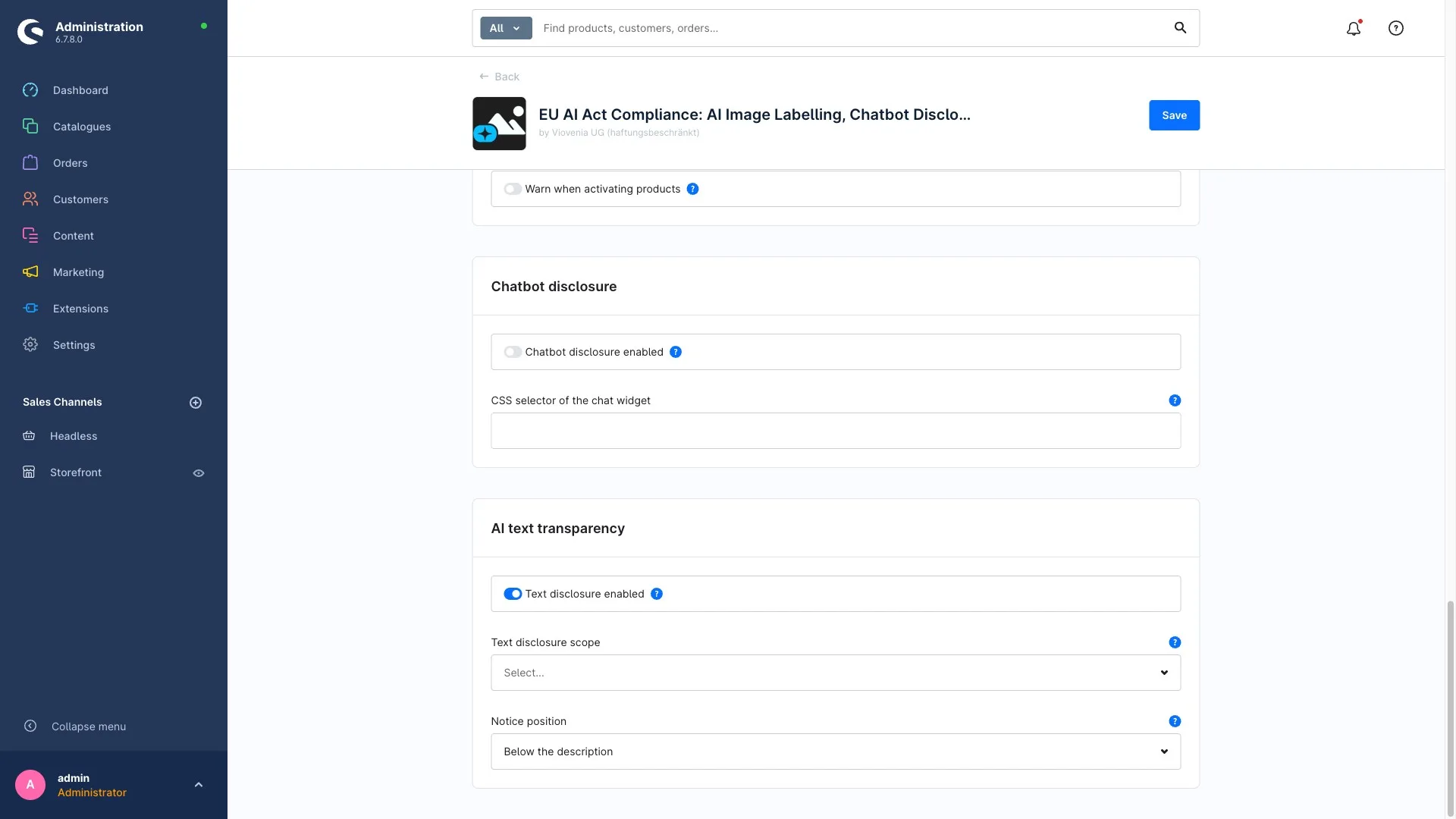
Our plugin EU AI Act Compliance treats text exactly as the legal situation suggests: as an origin statement with an optional notice. Per product you choose human, AI-created or AI-created, editorially reviewed. The text notice on the product page is off by default; if you switch it on, you decide for which origin it appears and in which position – for human-written text it never appears. The product-wide aggregate disclosure summarises which content types of a product are AI-labelled, and the coverage dashboard shows how many product texts already have an origin.
The duties that matter run alongside automatically: the badge on AI images in listing, gallery, zoom and shopping experiences, the chatbot notice before the first interaction, the register as evidence. For the origin of your images the plugin reads C2PA and IPTC metadata on upload. And for the alt text that, per the guidelines, doesn't fall under Art. 50 at all, there's Alt-Text Optimizer Pro – without a label, because none is needed.
Checklist for AI text in the store
- Maintain the origin – on every product, even without a visible notice. Google wants it in the feed, the register wants it as evidence.
- Check sensitive claims – health, safety, sustainability: fact-check, sign-off by a person, no AI changes afterwards, responsible person in the legal notice.
- Check content, not just origin – material, dimensions, certificates, scope of delivery. Unfair-competition law doesn't ask who made the mistake.
- Keep reviews separate – no AI-written reviews; AI summaries recognisable as such.
- Decide on the notice deliberately – where, in which variant, with which wording; then be consistent.
- Images and chatbot first – that's where the duty is, that's where the enforcement risk is.
Frequently asked questions
Do I have to label AI-generated product descriptions?
Not under Art. 50 AI Act. The duty for text applies only to published text on matters of public interest; the Commission guidelines explicitly list advertising and product descriptions as an example outside the scope. A grey area remains for claims about health, consumer safety or sustainability – there the exemption for human-reviewed text with editorial responsibility helps.
Does the same apply to AI images in the store?
No, for images the duty is stricter. An AI-generated or substantially manipulated image showing realistic-looking people, objects or places is a deepfake within the meaning of the regulation and must be labelled visibly. The guidelines cite as an example a product image that makes the product look more attractive or of better quality. A real product on an AI background isn’t a deepfake as long as it doesn’t mislead.
Is a spell check enough as “human review”?
No. The guidelines name fact-checking as the minimum requirement and explicitly exclude superficial, purely formal checks such as spelling or grammar correction. In addition, no substantive AI intervention may occur after sign-off, and the editorially responsible person must be named publicly, for example in the legal notice.
May I have customer reviews written by AI?
No. Annex no. 23c to the German UWG – implementing the EU Unfair Commercial Practices Directive – prohibits submitting or commissioning fake consumer reviews; an AI-written review is fake regardless of any label. AI summaries of real reviews are allowed as long as they don’t misrepresent the reviews; they should be recognisable as summaries.
What does Google require for AI product copy?
In Merchant Center, AI-created descriptions should be submitted via the structured_description attribute with digital_source_type set to trained_algorithmic_media; AI images must carry IPTC metadata about their AI origin, which must not be removed. In Search there is no labelling duty, but a spam policy against mass-produced content made to manipulate rankings. Since July 2026 Google Ads allows visible AI labels in ads.
Does an AI notice hurt sales?
The 2026 evidence is mixed: three quarters of Germans want disclosure, but in the Hochschule Hannover experiment an “AI-generated” label lowered attitude and purchase intent – even for real photos. In another study, labelled text reduced trust more than labelled images. In practice it works to always maintain the origin and to use the notice selectively where it builds trust.
Sources
Retrieved November 7, 2026:
- Regulation (EU) 2024/1689, Art. 3(60), Art. 50, Art. 99 and Regulation (EU) 2026/1744 (Digital Omnibus)
- Commission guidelines on the transparency obligations under Art. 50, C(2026) 7702 final
- Code of Practice on Transparency of AI-generated Content and Commission opinion on its adequacy
- Wettbewerbszentrale: guide on labelling AI-generated content, version 2.0 of July 29, 2026
- Higher Regional Court of Hamm, press release of May 12, 2026 (I-4 UKl 3/25)
- Section 5 UWG, Section 5a UWG, Annex to Section 3(3) UWG
- Google: Merchant Center – description, Merchant Center – image link, Google Ads – AI labeling requirements, Search Central on AI content, spam policies
- Ipsos AI Monitor 2026, press release of July 23, 2026, FHNW online retailer survey 2026, etailment on the Hochschule Hannover study, MEEDIA on the Macromedia study
Bottom line
The AI Act doesn't require a label under your product description. It requires one on the AI product image, at the chatbot and on text that informs the public about health, safety or sustainability. Everything else is your decision – with Google, unfair-competition law and your customers in mind.
Take your ten best-selling products and ask for each: who wrote the text, who checked it, and does it contain a claim someone has to stand behind? The answers belong on the product – visible or not. And if you have questions while setting up, the plugin documentation helps, or a short conversation with us.